Adopting governance means rewriting your apps
Point your SDK at Vidai and use a Vidai key. Nothing else in your code changes, and from that call on, every rule, price and record applies.
The problem
You want every AI call in the company governed: who may call which model, what data may go, what it costs. But the apps already exist. There are dozens of them, written by different teams, in different languages, against different SDKs. Every governance plan you've seen starts with "first, add this to every service".
Why it stays unsolved
Governance usually arrives as code: a wrapper library, a tracing SDK, a logging hook, a guardrail call before every prompt. Each one has to be added to every service, kept up to date in every service, and remembered by every new service. The teams with deadlines don't adopt it; the ones who do adopt it pin an old version. The service nobody touched in a year is the one that leaks.
How Vidai handles it
Vidai sits in the path the call already takes. Your program keeps its SDK and its code; you change two settings:
from openai import OpenAI

# Before: client = OpenAI(api_key=os.environ["OPENAI_API_KEY"])
client = OpenAI(
    base_url="https://<your-gateway>/v1",
    api_key=os.environ["VIDAI_KEY"],
)

reply = client.chat.completions.create(
    model="gpt-4o-mini",
    messages=[{"role": "user", "content": "Draft three taglines for a dairy brand."}],
)
import Anthropic from "@anthropic-ai/sdk";

// Before: new Anthropic({ apiKey: process.env.ANTHROPIC_API_KEY })
const client = new Anthropic({
  baseURL: "https://<your-gateway>",
  apiKey: process.env.VIDAI_KEY,
});
curl https://<your-gateway>/v1/chat/completions \
  -H "Authorization: Bearer $VIDAI_KEY" \
  -H "Content-Type: application/json" \
  -d '{"model": "gpt-4o-mini", "messages": [{"role": "user", "content": "Hello"}]}'
That's the whole change. The provider key leaves your app: the gateway holds your provider keys and uses them on your behalf. The same two settings work for the OpenAI, Anthropic and Gemini SDKs and the tools built on them, such as LangChain, LiteLLM and Google ADK.
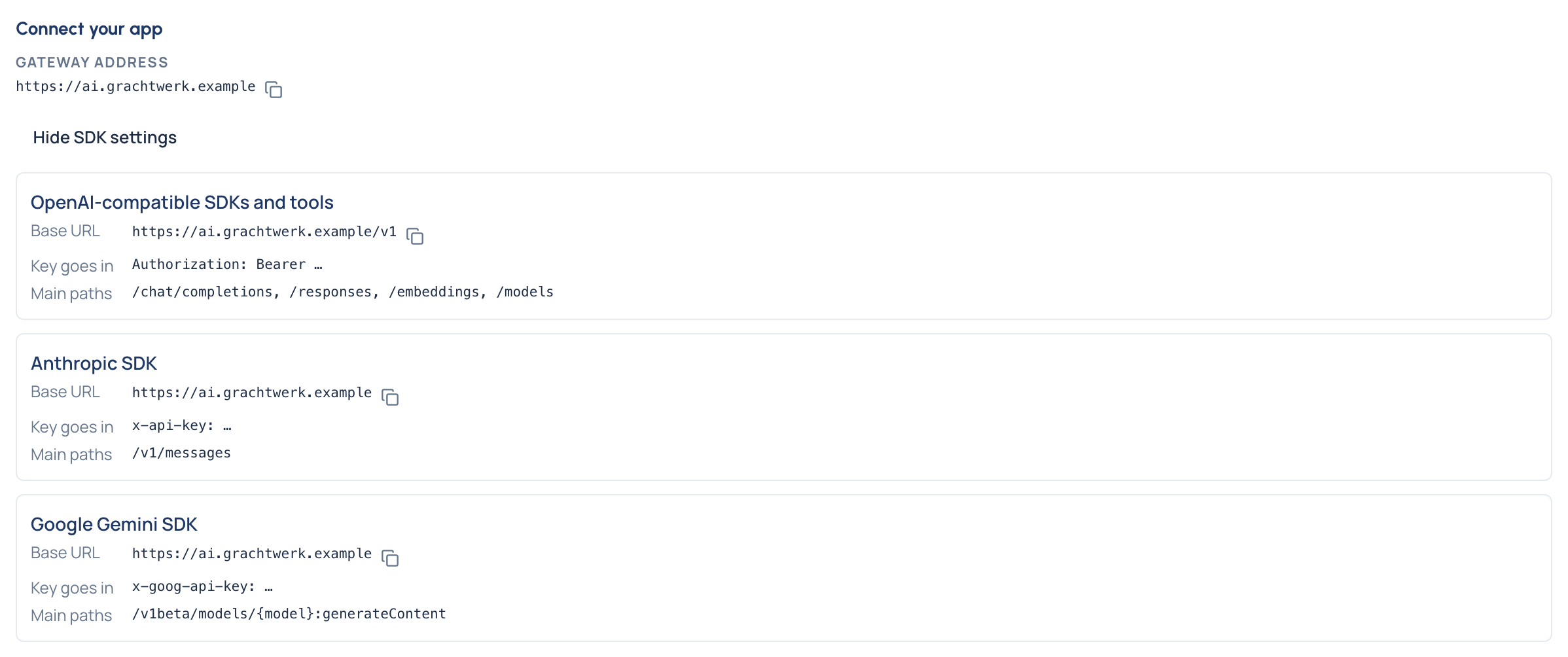
You don't have to look the settings up. Connect your app, on Keys and wherever a key is issued, shows the gateway's address and, for each kind of SDK, the base URL to copy and where the key goes.
What changes for you
- Governance on day one, not after a migration. Every call through the gateway is checked, priced and recorded, including calls from the service nobody has touched in a year.
- Provider keys stop living in config files. A Vidai key belongs to a person or an agent, can be rotated, turned off or limited on its own, and a leaked one is stopped in one click. See Keys.
- Rules change without a deploy. A new model allowed, a guardrail enforced, a budget set: the gateway applies it within seconds, and no app is redeployed.
- Proof: try it in fifteen minutes with Your first call, then find the call in Request logs with its cost.