The Enterprise AI Control Room.
Govern cost, compliance and data in every AI request.
Not another alert to triage. Vidai decides on every AI call as it happens: who may make it, what data may go, where it may run and what it may cost. It applies your rules before the risk happens, and records the proof. Your apps change one line; your organisation gets one place to govern all of its AI.
Governance you can act on
Vidai governs the two things every organisation using AI answers for: cost and compliance. Compliance has two sides: regulatory governance (the regulations you follow, how long records are kept, the evidence) and data governance (what data reaches which model, and where it may be processed).
| The outcome | What acts on every call | |
|---|---|---|
| Cost governance | Every call priced and owned; spend stopped or rerouted at the limit | Budgets, model access, routing to cheaper models |
| Regulatory governance | The regulations you follow, applied and evidenced | Policies from regulation packs, retention, sealed records, auditor reports |
| Data governance | Sensitive data kept out of models, and inside the regions you chose | Guardrails and VidaiGuard, region rules, approved models |
What you get, each with its proof
-
Risk acted on, not just observed
Cost, regulatory and data rules are decided on every call before it reaches a model, and recorded as proof.
Proof: a refused or masked call in Request logs names the rule that acted. Governance in the traffic
-
Change one line
Point your SDK's base URL at Vidai and use a Vidai key. Nothing else in your code changes, and provider keys leave your apps.
Proof: the before and after, in three SDKs. Adopting governance
-
Use any model your way
Keep the SDK you have (OpenAI, Anthropic or Gemini) and call any provider. Requests, streams and tool calls are translated both ways.
Proof: the translation grid. Any SDK to any provider
-
Every call governed and recorded, with no instrumentation
Rules, cost, logs and evidence happen in the request path, for every app, without SDK patches or agents in your code.
Proof: a call's page: who, which model, tokens, cost, rules. Seeing without instrumenting
-
Yours
Runs on your infrastructure, with your providers and your keys. Prompts stay there; nothing phones home.
Proof: the architecture, part by part. The parts
-
Fast enough to forget
47,200 calls a second at a 0.58 ms median, every call recorded: the gateway's 0.9.0-beta.5 run on one machine, 32 concurrent callers, a mock provider; our own measurement, not a published benchmark.
See it working
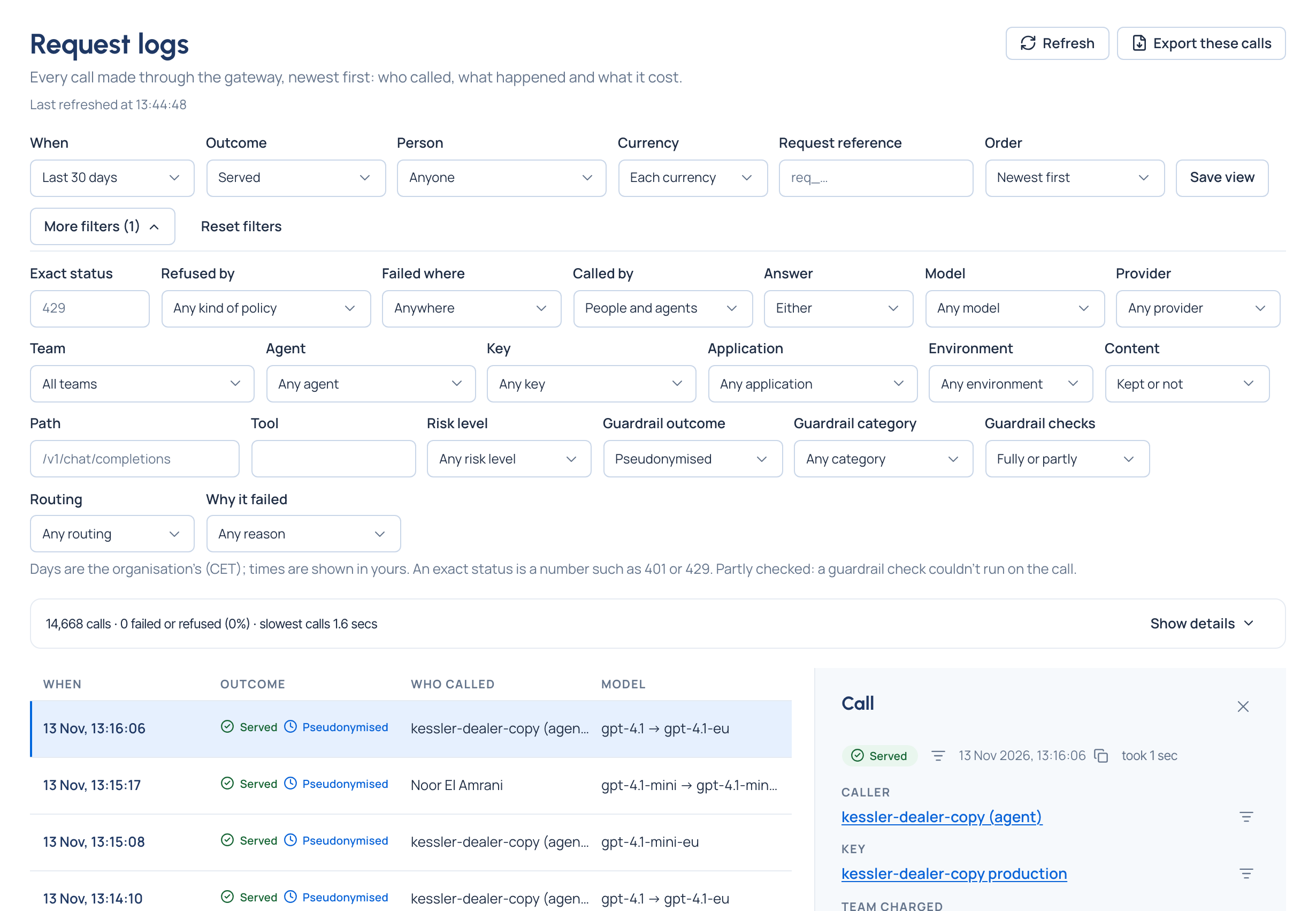
A call's whole story. Every call through the gateway, from any app, recorded the same way: who made it, which model was asked for and which answered, what every rule did, and what it cost.
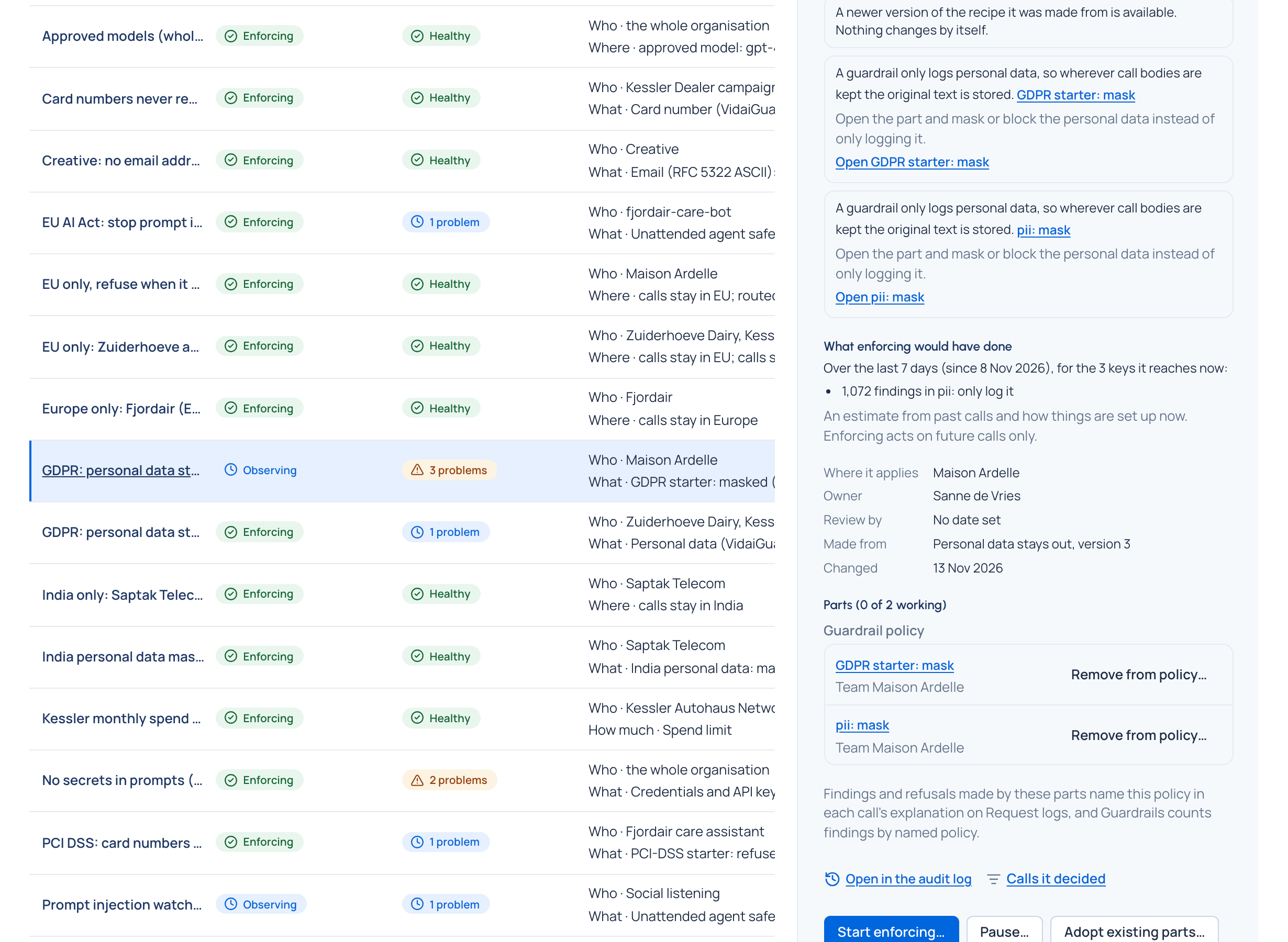
A policy, read as a sentence. "GDPR: personal data stays out (Zuiderhoeve, Kessler)": who it covers, what it does, whether it's observing or enforcing, and every call it decided.
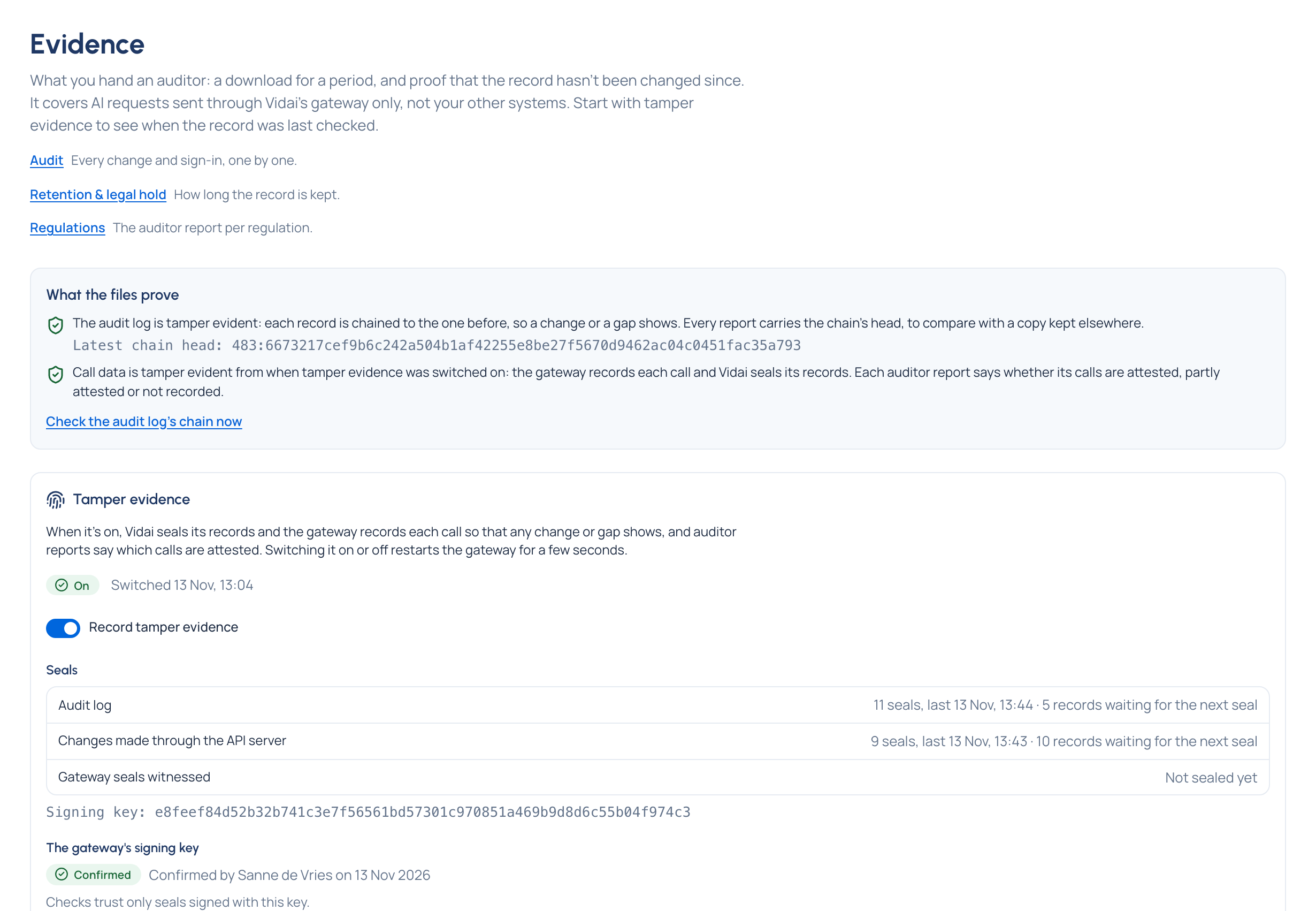
Evidence, verified. Records sealed and signed on both sides, checked daily, and a report an auditor verifies on their own machine.
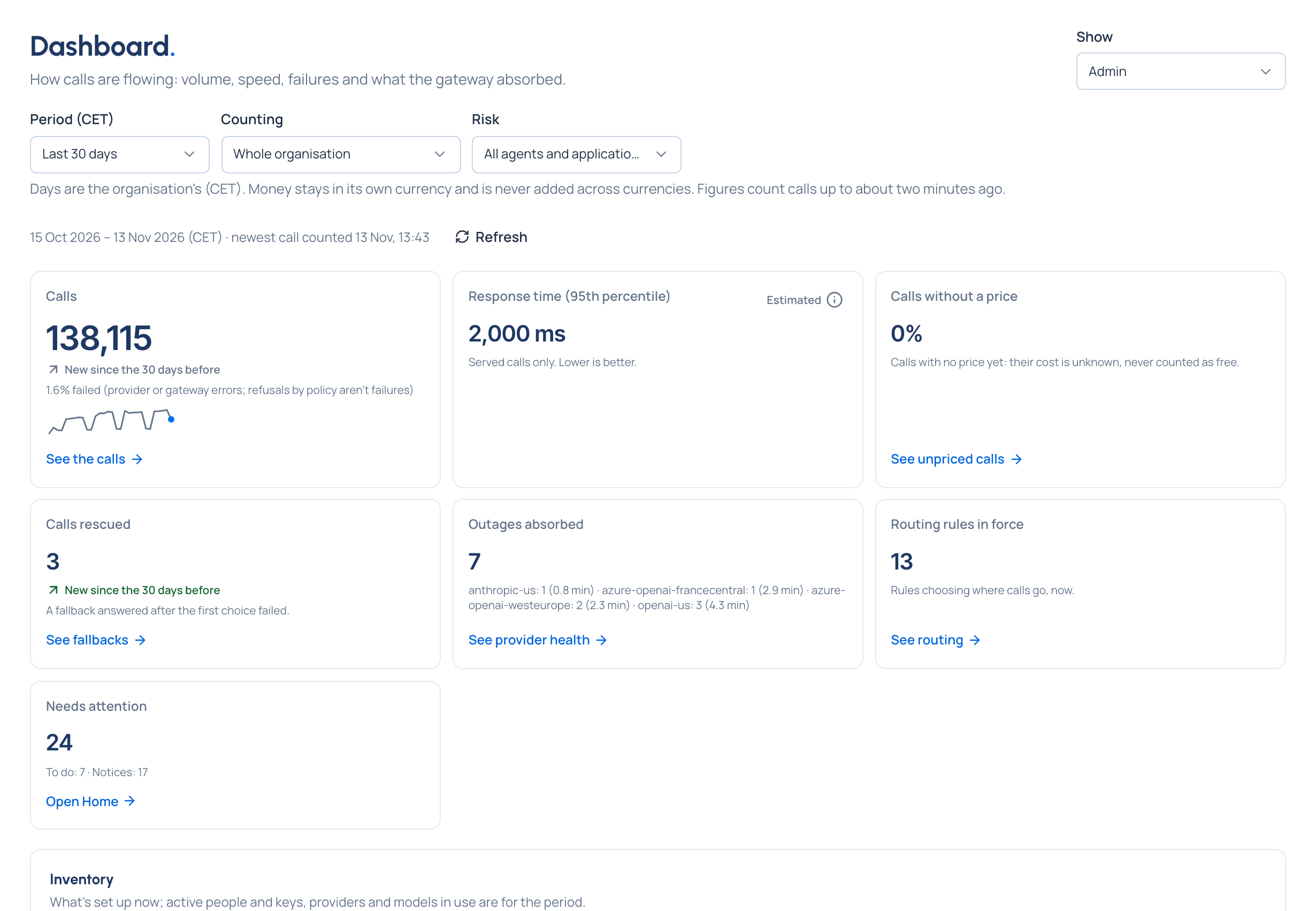
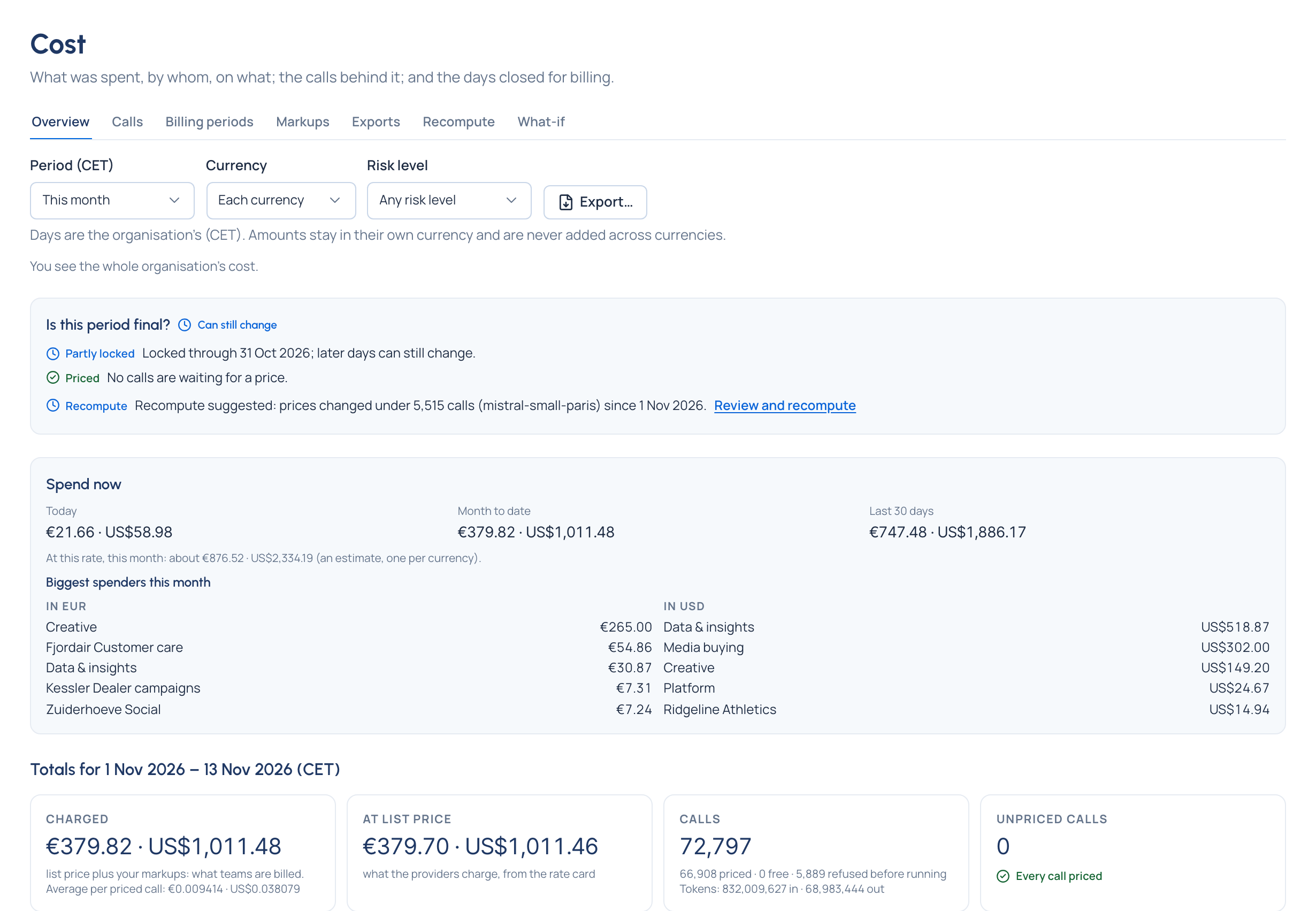
Spend you can explain before the invoice. Every call priced within minutes and charged to the team that made it.
What you gain
| You are | What changes for you | Start with |
|---|---|---|
| Evaluating or buying | One place to govern every AI call, on your own infrastructure | For evaluators and buyers |
| A developer | One base URL, one key, any model; every refusal explained | For developers |
| An organisation admin | People, teams, keys and rules in one place; never locked out | For organisation admins |
| A group admin | Run your own team within the organisation's rules | For group admins |
| A user | Your key, your models, your usage, and why a call was refused | For users |
| In Finance | Cost by team, app, agent and person within minutes; budgets that act | For Finance and FinOps |
| A compliance officer | Policies enforced on every call; evidence on demand | For compliance officers |
| An auditor | A report you verify alone, offline | For auditors |
| In security | Self-hosted, keys held centrally, every call recorded | For security (CISO) |
Start here
- Why it exists: the problems we take on, one page each.
- How it fits together: How Vidai works, one picture and a short read.
- A first success: Get started: a call through the gateway, seen in Request logs with its cost.
- Connect your app: Client integrations: your SDK, framework or tool, set up in two settings.
- Then your own path: pick your role above, or browse Concepts.
Editions
Vidai comes in two editions. Community is a complete governance platform on its own: people, roles, keys, model access, guardrails with pattern checks, routing and resilience, regulations and retention, the tamper-evident audit log, cost and budgets, Request logs and dashboards. Enterprise adds features such as single sign-on, VidaiGuard, region rules, sealed evidence with the auditor report and evidence pack, coverage per control, and the Compliance officer role; what it includes depends on the features your licence includes. Moving between editions loses nothing. See Editions and licences.