Supported providers
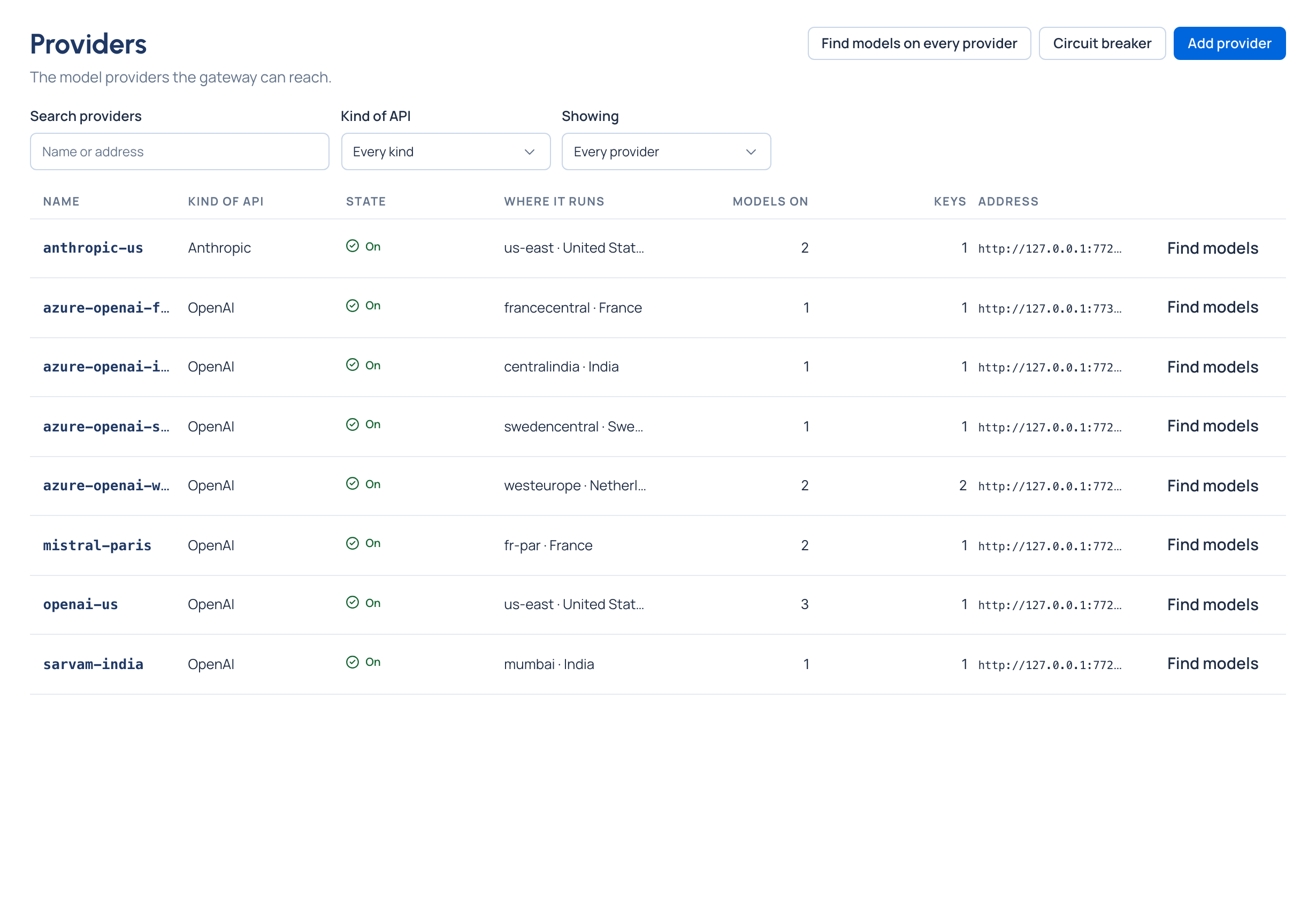
Before you commit, you want to know the AI services you already pay for will plug in, in the regions you're allowed to use. This page lists the providers Vidai connects out of the box, how each is added, where it can run, and how the gateway reads its usage and prices it. Your apps call any of them in the SDK format they already use: see Any SDK to any provider.
Add one in Models & routing › Providers › Add provider; the steps are in Add a provider.
Kinds of API
Every provider speaks one kind of API, fixed when it's added. To use another kind, or the same one somewhere else, add another provider.
| Kind of API | Used by |
|---|---|
| OpenAI | OpenAI, and every OpenAI-compatible address: the known addresses below, Ollama and your own servers |
| Anthropic | Anthropic |
| Azure OpenAI | Your Azure OpenAI resources |
| Google Gemini | Google AI Studio's own API |
| AWS Bedrock | Your AWS account's Bedrock models |
| Google Vertex AI | Your Google Cloud project's Vertex AI models |
| IBM watsonx | IBM watsonx |
| GitHub Copilot | GitHub Copilot |
| Replicate | Replicate |
Known addresses
Picking one fills in the kind of API, the address, how usage is read and a name; you add the API key. Where each runs is worked out by Vidai and shown before you save. The list comes from Vidai itself, so a new regional address appears without an update to the Control room.
| Provider | Regions offered |
|---|---|
| OpenAI | Global, European Union, United States (a regional address needs a key from a project made in that region) |
| Anthropic | One address |
| Google AI Studio | Two entries: its own Gemini API, and its OpenAI-compatible API |
| Qwen | Singapore, Beijing, Virginia |
| Mistral | Its main address (may run anywhere), and its EU and US addresses |
| IBM watsonx | Five regions |
| Groq, DeepSeek, xAI, Together AI, Fireworks, Cerebras, Perplexity, DeepInfra, Sarvam, Scaleway | One address each |
| OpenRouter | One address, placed global: it may send each call to any maker anywhere, so it never satisfies a regional rule |
Anthropic and Google AI Studio have no EU address: in the EU, reach Claude through AWS Bedrock and Gemini through Google Vertex AI.
Cloud platforms
The address carries your own resource or region, so you give those parts as fields of their own.
| Provider | You give | Good to know |
|---|---|---|
| Azure OpenAI | Resource name, the API key, optionally an API version (empty uses the gateway's default) | One provider serves one resource. Test connection checks the address and key; Azure lists what a resource could deploy, not its deployments, so you add each deployment as a model by hand |
| AWS Bedrock | AWS region, and AWS credentials: AWS access key id with AWS secret access key, plus an AWS session token for temporary credentials | Leave the key id and secret empty to use the AWS credentials in the gateway's own environment (not instance or task roles). Temporary credentials expire: give a new session token before they do. A model id starting eu., us. or apac. runs within that geography; one starting global. may run anywhere, so no regional rule lets it through |
| Google Vertex AI | Google Cloud location and Project ID | Uses Google Cloud credentials |
On Bedrock, Claude is reached in its own format; Amazon Nova, Llama, Mistral and Cohere models take text only (no image or document input) when called through another format. See the endpoints grid.
Your own machines
| Provider | Address | Good to know |
|---|---|---|
| Ollama | http://localhost:11434/v1 (change it if Ollama runs elsewhere) |
Ollama doesn't check the key; ollama is filled in. You say where it runs (a location in your own words and an area) |
| Custom | Any OpenAI-compatible address: your own server, for example | You say where it runs. Usage is read as OpenAI reports it unless you choose otherwise |
An Ollama or custom provider is Not priced until you choose a provider on the rate card to price it from, or mark its models free. Its calls are counted as unpriced, never as zero.
Testing, finding models and serving extra APIs
| Which providers | |
|---|---|
| Test connection before adding (asks the provider for its models with the address and key you typed; nothing is saved) | OpenAI, Anthropic, Google Gemini and Azure OpenAI kinds. Others can't be tested before adding, and the form says so |
| Find models (asks the provider which models it offers; new ones arrive switched off) | Any provider whose kind can list its models; Find models now is ticked when it can |
| Responses API through the gateway | OpenAI and Azure OpenAI kinds: Served, Not served or The gateway's default for its kind |
| Files API and batches through the gateway | Served, Not served or The gateway's default for its kind, per provider |
How usage and prices are read
- How usage is read: each provider reads token counts from its answers the way its maker reports them: OpenAI, Anthropic, Google, Mistral, DeepSeek, Qwen, Together, Ollama, OpenRouter, xAI, Groq or Custom. A known address fills it in; you can change it on Connection.
- Priced from: Work it out from its kind, a provider on the rate card, or Not priced.
- List cost from: the rate card's prices, or what the provider reports for each call (OpenRouter's default). A call a provider reports as costing nothing is left unpriced, not free. Markups apply on top either way.
- Price in: the currency a provider's models are priced in, where the rate card publishes more than one. Prices are never converted.
Several keys and agreements
- A provider can hold several upstream keys, chosen in turn, at random, by weight, or the main key only. See Provider keys and resilience.
- A provider records its agreements (a data processing agreement, a business associate agreement, a PCI DSS attestation), each with a reference and an end date; a region rule can require them. See Regions and data residency.
Related
- Providers and models
- Add a provider
- Say where a provider runs, or add it in another region
- Find a provider's models and switch them on
- Endpoints: what each SDK format reaches on each provider