Policies and regulations
A regulation lives in a document; whether it's applied depends on every team reading it the same way. In Vidai a regulation becomes rules in the request path. A policy gathers the rules that serve one intent ("GDPR for the booking assistant") under one name, with an owner, a review date and a state. A regulation your organisation follows sets how long records are kept, proposes the policies that serve it, and shows each of its controls as enforced, observed or a gap. You see what you cover, and what is still your own process.
Policies
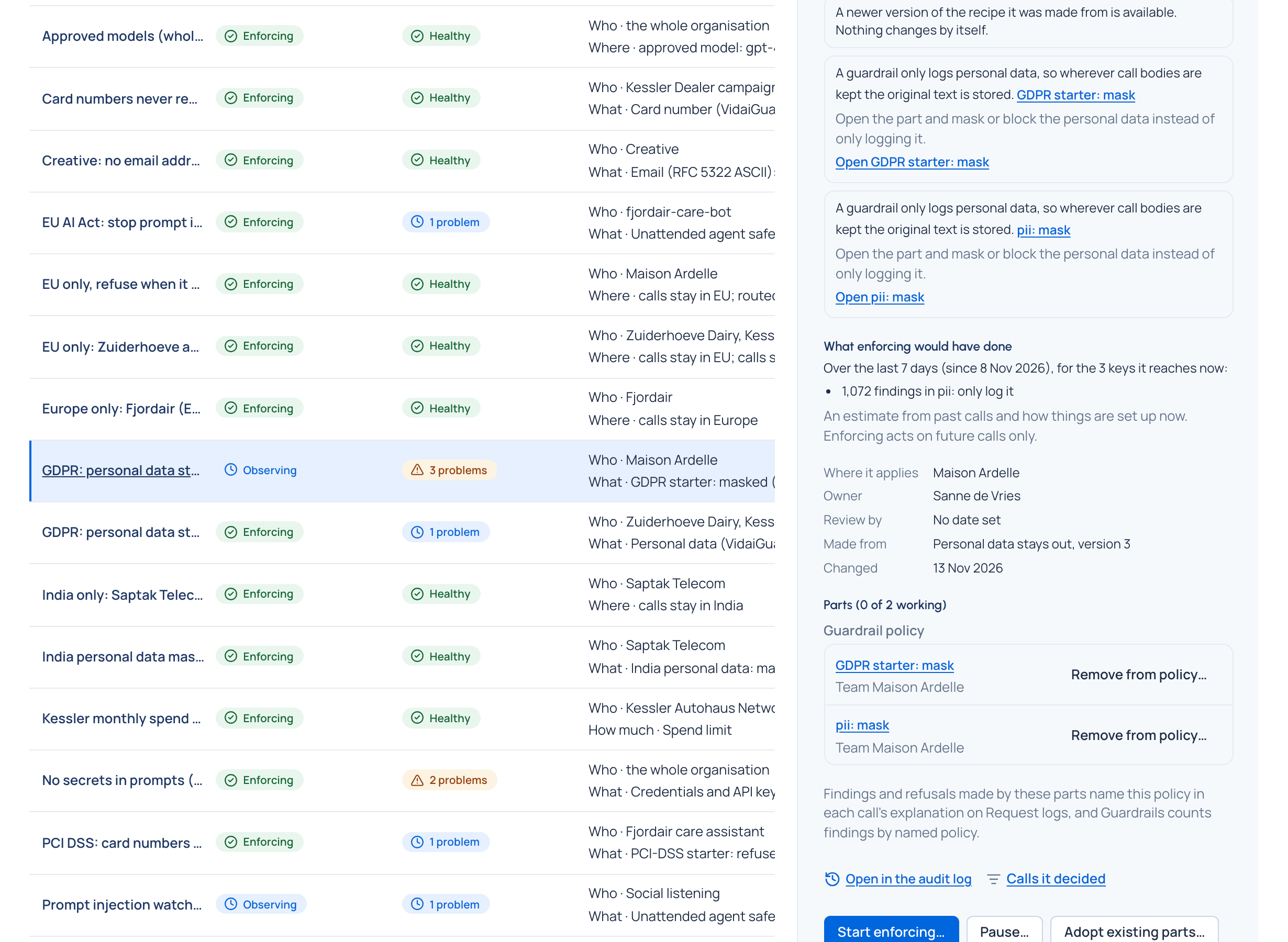
A policy says what you intend, for whom. Its parts are ordinary rules: guardrails, region rules, compliance routes and approved destinations, routing rules and budgets. Each part keeps its own behaviour (levels only tighten, the strongest action wins). The policy names and governs them; it never decides a call on its own.
A policy reads back as sentences, one per dimension:
- Who · the teams, applications or people it's for;
- What · what its guardrails find and what happens: "Email address: masked (watching)";
- Where · "calls stay in EU", routes, approved models;
- How much · a budget it holds.
flowchart LR
  Reg[Regulation followed<br/>e.g. GDPR] -->|proposes| Pol[Policy<br/>owner · review date · state]
  Reg -->|sets| Ret[Retention floors]
  Pol --> G[Guardrails]
  Pol --> RR[Region rules and routes]
  Pol --> AD[Approved destinations]
  Pol --> RT[Routing rules]
  Pol --> B[Budgets]
G & RR & AD & RT & B --> Calls[Every call they reach]States
| State | What its parts do |
|---|---|
| Draft | Nothing is applied |
| Observing | Guardrail parts log what they find without acting; other parts aren't applied yet |
| Enforcing | Every part is in force |
| Paused | Every part is lifted until someone resumes it, with a reason kept in the audit log |
While a policy observes, What enforcing would have done shows the last seven days: findings by category and what would have been done, calls that went outside its areas, calls its routes would have sent elsewhere.
Making one
- New policy asks three optional questions (who is it for, what must not be sent, where may calls go) and reads the policy back as you answer: "For Customer support, when a request contains Email address, mask it before any model sees it. Calls from Customer support stay in EU." Check what it changes runs a dry run for each part before anything is saved; all the parts are made, or none.
- Recipes are templates: answer a few questions and a recipe makes the policy and its parts. Built-ins include Personal data stays out (GDPR), Protect health data (HIPAA), Keep card numbers out (PCI DSS), No secrets in prompts, Stop prompt injection (EU AI Act), Keep an application in a region, Only approved models and Spend limit. They start Observing, so nothing is stopped until you enforce. A recipe sets controls; it isn't a statement of conformity.
Regulations
Vidai lists the regulations it knows: GDPR and UK GDPR, the EU AI Act, ISO/IEC 42001, HIPAA, PCI DSS, CCPA, India's DPDP Act, ISO/IEC 27001, SOC 2, SOX, FCA and MiFID II, SEC 17a-4, and the GCC's laws and rules (UAE PDPL, DIFC Data Protection Law, ADGM Data Protection Regulations 2021, Qatar PDPPL, Saudi PDPL and more; the full list is in Regulation packs). A regulation is followed only when someone chooses it. Following one:
- sets the retention it requires, and never shortens a period behind your back (see Retention, legal hold and subject requests);
- offers its recommended policies, made watching first;
- shows coverage control by control Enterprise, gaps first.
What Enterprise includes depends on the features your licence includes. Following a regulation, its retention and its policies are in every edition.
Coverage, never "done"
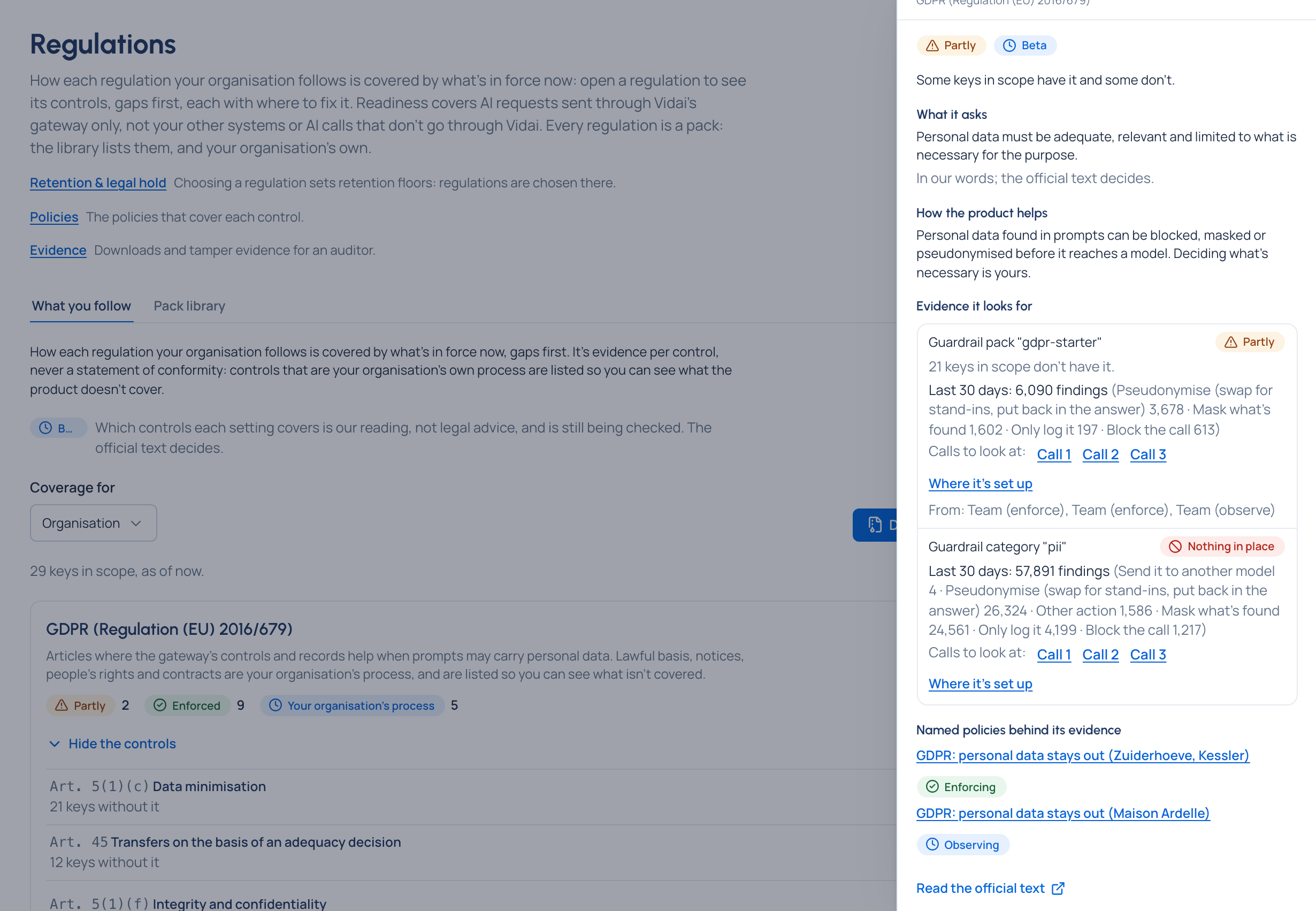
| State | Meaning |
|---|---|
| Nothing in place | Nothing in scope provides it yet |
| Not checked | It needs VidaiGuard. Where VidaiGuard isn't set up, this is calm: pattern checks still act, and it starts once VidaiGuard is set up. Where it's set up but switched off or not answering, it's a warning |
| Partly | Some keys have it and some don't |
| Observed only | It's watched and logged, but some keys only observe |
| Enforced | Every key in scope has it in force |
| Your organisation's process | The product doesn't cover it; always listed, never hidden |
A control covered by a pack whose VidaiGuard checks don't run right now says Partly by patterns, with why (VidaiGuard isn't set up, its checks are switched off, or it isn't answering), on its row and in its panel. Its pattern checks cover it meanwhile.
A control's page says what it asks, how the product helps, each piece of evidence with where it's set up, and what its guardrails did in the last 30 days. Coverage is evidence per control: your auditor makes the call, and the Control room never claims the regulation is met.
Regulation packs
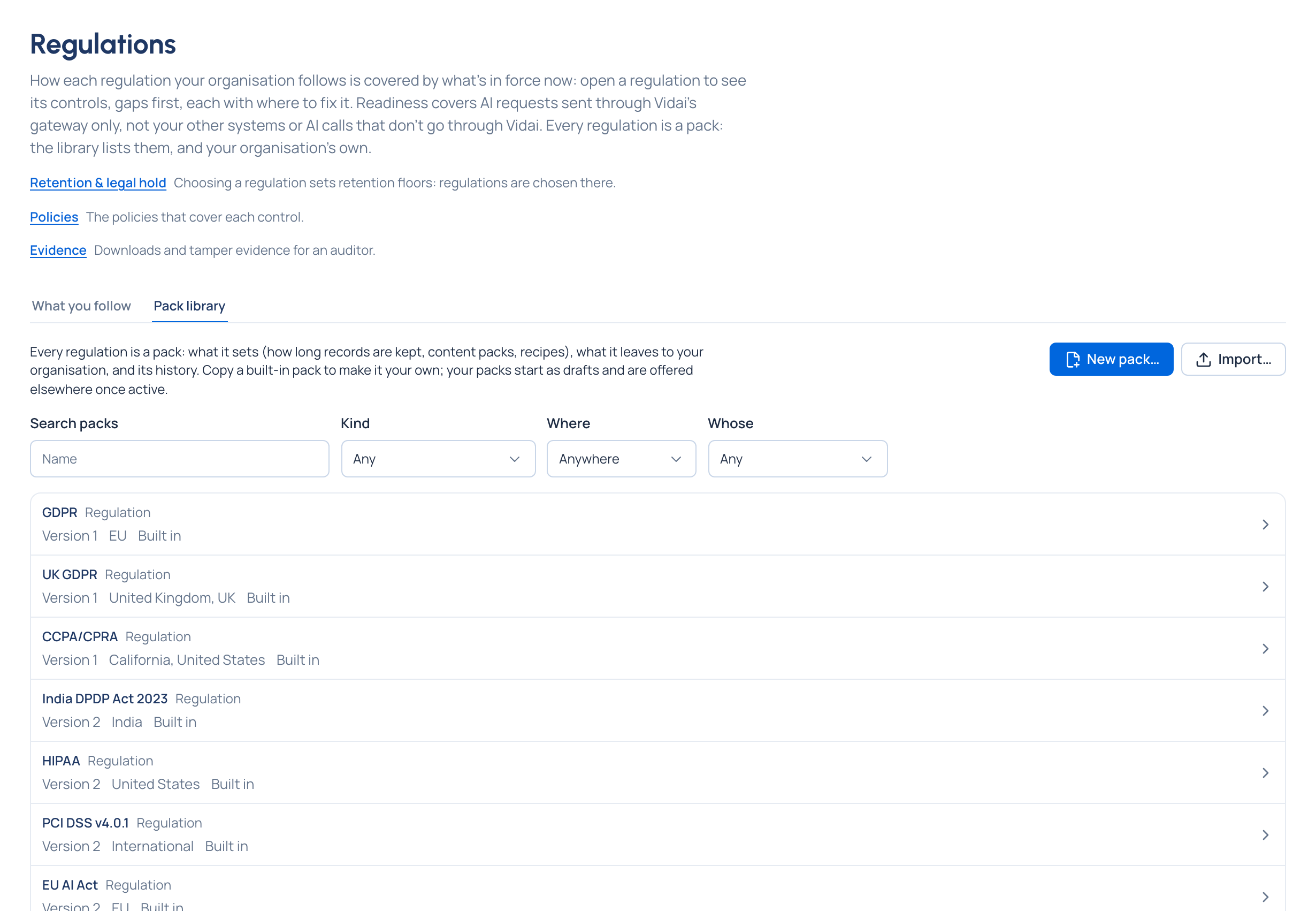
Every regulation is a versioned pack: what it sets, what it leaves to your organisation, its sources and its history. Copy one to tighten it (a copy may only keep records longer, and each difference carries a reason), or import and export packs between installations with a checksum and, where you have an evidence key, a signature. When a release changes a built-in pack, your copy stays as it is until you review the change.
Related
- Guardrails · Regions and data residency
- Risk and AI systems: risk levels the EU AI Act asks for
- Tamper evidence: the auditor report and evidence pack for a regulation
- Exceptions, overrides and approvals: lifting a whole policy for one key
- Rules at levels