Data and people's rights
The problem. AI calls carry personal data. One regulation says keep the logs; another says delete personal data as soon as you can. A person asks for a copy of their data, or for it to be erased, and nobody knows which calls hold it. With Vidai, retention follows the regulations you chose and never shortens by itself, clashes are shown and decided on the record, legal hold stops all deletion, reading a prompt is a role of its own, and a data subject request finds the calls and says what happened to each.
How long each kind of record is kept
Proof › Retention & legal hold says how long Vidai and the gateway keep each kind of record before deleting it:
| Record | What it covers |
|---|---|
| Prompt and reply text | What was sent and what came back. The gateway holds it; Vidai never stores it |
| Call records | Who called what, when, the outcome, findings and cost |
| Tamper-evident records Enterprise | The gateway's tamper-evident records and their seals |
| Audit log | Who changed what. Kept for good; erasing someone removes their details, never the record |
Each regulation you follow sets a floor, the shortest time some records must be kept ("EU AI Act needs 180 days"). Minimisation laws such as GDPR let you set a ceiling, the longest you keep personal data. A period below a floor is refused, naming the regulation. Each row also shows what the gateway last reported, so you see the setting reached it.
Deleting can't be undone, so Vidai never shortens a period by itself. When you stop following a regulation, its floors stop applying and your periods stay as they are until you change them.
When two regulations disagree
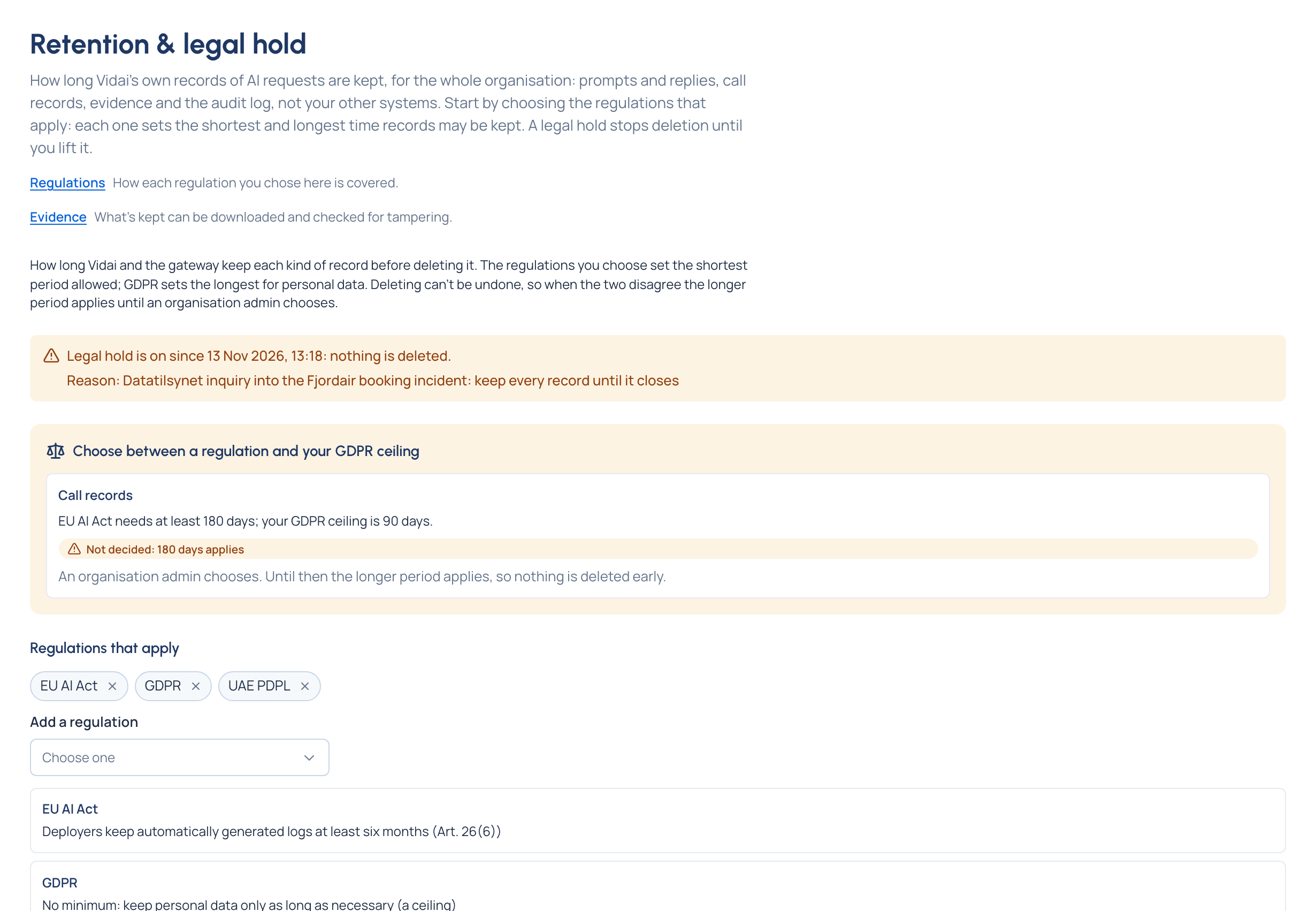
Following GDPR and the EU AI Act together is common, and they can disagree: the EU AI Act wants call records kept at least 180 days, while your GDPR ceiling may say 90. Vidai doesn't guess. The clash is shown first on the page and on Home, and until an organisation admin decides, the longer period applies, so nothing is deleted early. The admin keeps the regulation's floor or your ceiling, with a reason kept in the audit log. If either side changes later, the choice lapses and you're asked again. See Decide a retention clash.
Legal hold
Hold every record is a switch of its own. While it's on, nothing is deleted, by Vidai or by the gateway; every row reads "Forever" and says what applies once it's lifted. Putting it on or lifting it asks for a reason, recorded in the audit log. A data subject request to erase content is refused while a hold is on. Retention and legal hold are in every edition.
Prompts stay private by default
Reading what a call sent and got back needs the Content reader role, on the whole organisation or on a team, an agent or an application. Prompts are often personal data, so no other role includes it: not even organisation admins. Every read, and every refused attempt, is recorded in the audit log, naming the call and never what it said.
Data subject requests
Proof › Data subject requests answers someone who asks, under data protection law (GDPR, UK GDPR, CCPA, India's DPDP Act and the Gulf laws), for a copy of their data or for it to be erased.
- Whose calls: a person, an agent, a key, an application, or an end user your applications name in their requests, over up to a year.
- A copy of their calls: a JSON Lines file. Content is included only where the person making the request may read it; every inclusion is recorded.
- Their content erased: what the calls sent and got back is erased here and on the gateway; the calls' records stay, without content. Each call then says what happened to it:
| Outcome | What it means |
|---|---|
| Erased | Here and on the gateway |
| Waiting for the gateway | Erased here; the gateway's copy goes when its own job runs |
| Held by the gateway | Erased here; the gateway's legal hold keeps its copy until lifted |
| Kept by a regulation | Younger than a regulation you follow needs content kept; it stays until then |
| Nothing kept | The gateway didn't keep its content |
In Request logs, an erased call's content reads Erased.