Request logs and the call record
When an app reports "the AI call failed", or a cost looks wrong, the answer usually sits in several places: the app's own logs, the provider's console, an invoice. In Vidai every call through the gateway is recorded the same way, with no instrumentation in your code: who made it, with which key, which model was asked for and which answered, what every rule did, what it cost. Request logs lists them, and a call's page tells its whole story.
What a call's record holds
| Part | What it says |
|---|---|
| Outcome | Served, Refused, Limited or Failed, when, how long it took, and for a call that didn't succeed one sentence on where it stopped |
| Who | Caller (a person or an agent), Key, Team charged, Environment |
| Models | Model asked for and Answered by, with the provider. A Routed or Fallback mark says when another model answered, and why |
| Why this happened | Every rule that acted, in the order the gateway weighed them (access, budget, guardrail, routing, compliance route, fallback), each with its name, purpose, level and what it did |
| Guardrails | What the pattern checks and VidaiGuard found, what was done (Blocked, Redirected, Pseudonymised, Masked, Logged only), and the policy that decided it |
| Fallback chain | Each model tried, Answered or Failed with why |
| Tools | The tools the call offered the model, and the ones it called |
| Usage and cost | Tokens in and out, the cost in its own currency (or Not priced and why, never $0), and how it was priced, part by part |
| Configuration | The settings the call ran under: the key's settings, who set them and when Enterprise |
| Technical details | The request reference, status, the gateway's and the provider's codes |
The Configuration section and its fingerprints come with tamper evidence, an Enterprise feature; what Enterprise includes depends on the features your licence includes. Everything else is in every edition.
One id, end to end
Every answer from the gateway carries x-vidai-request-id, errors included. Paste it into Request reference and
the call opens. A program can also send its own x-request-id, kept with the call, to join Vidai's records with its
own.
sequenceDiagram
  participant App
  participant Gateway
  participant Provider
  App->>Gateway: call with a key (and your own x-request-id)
  Gateway->>Gateway: key, access, budget, guardrails, routing
  Gateway->>Provider: the call, as allowed
  Provider-->>Gateway: answer
  Gateway-->>App: answer + x-vidai-request-id
  Gateway->>Gateway: call recorded
  Note over Gateway: listed in Request logs within seconds;<br/>counted in cost totals within about two minutes
Find the calls that matter
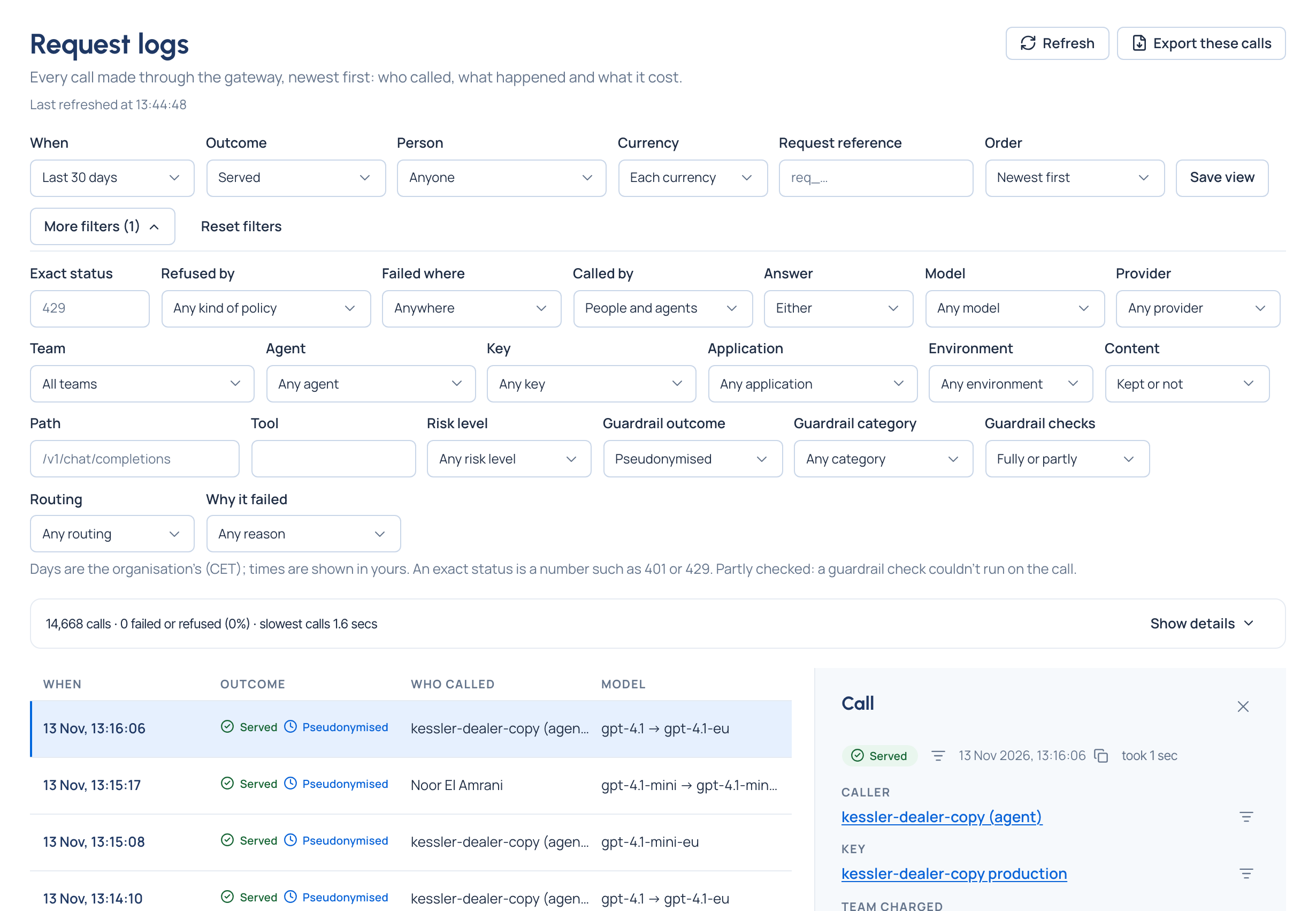
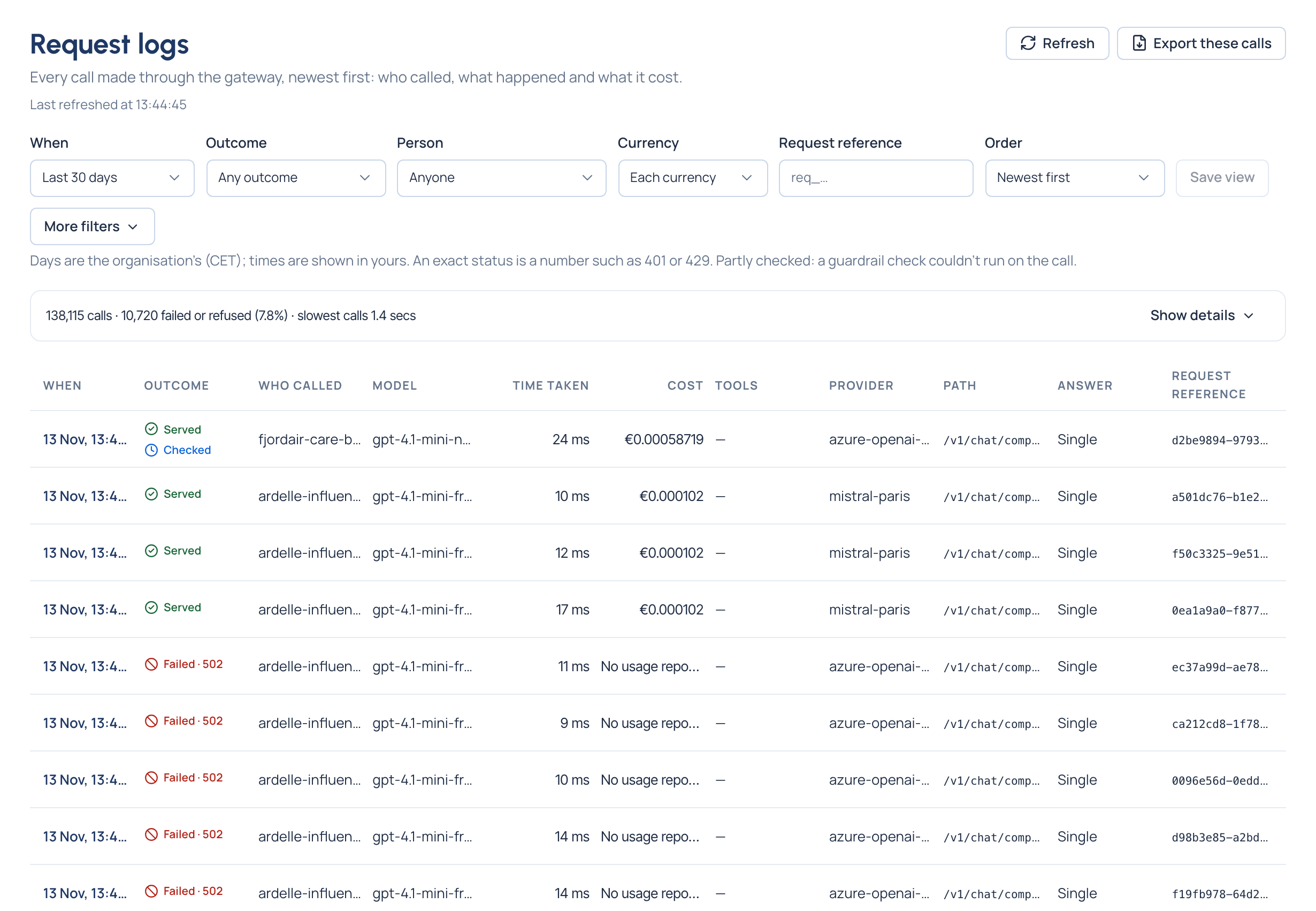
Filter by When, Outcome, Person or Request reference; More filters adds the exact status, what refused a call (Refused by: access or a region rule, routing, a guardrail, a budget, a compliance route, Stop AI traffic), model, provider, team, agent, key, application, environment, tool, guardrail outcome and category, and Routed only or Fallback only. A summary line gives the count, the share that failed or was refused, and how long the slowest took. Every routing rule, budget, guardrail and named policy has Calls it decided, opening only those calls.
Who sees which calls
Users see the calls made with their own keys and their agents' keys; group admins the calls charged to their teams; organisation admins, organisation viewers, Compliance officers and Finance every call. Anyone who can see a call can read Why this happened, so a refused developer can see in words why their call was refused.
Content stays private
The prompt and the reply are hidden. Show content appears only for a Content reader, a role of its own given on a team, application, agent or the whole organisation. No other role includes it, not even organisation admin. Every read, and every refused attempt, is recorded in the audit log, naming the call but never what it said. Content erased at someone's request reads Erased; the call's record stays.
Every call is listed, even when the gateway keeps no content for it: its outcome, time, tokens and cost are always
there. Which calls keep their full record is the gateway's choice: every call by default, or a steady sample, with
failed calls, calls a guardrail acted on, and calls a program marked with x-trace: true always kept.
Related
- Rules at levels: the order Why this happened follows
- Cost: the same call, from the money side
- Guardrails · Routing and fallback
- Retention, legal hold and subject requests: how long calls are kept
- Tamper evidence: proof a call's record wasn't changed