Governance lives in documents, not in traffic
Not another alert to triage. Vidai decides on every AI call as it happens: who may make it, what data may go, where it may run and what it may cost. It applies your rules before the risk happens, and records the proof.
The problem
The AI policy is approved. It says personal data doesn't go to external models, card numbers never leave, prompt injection is stopped, and exceptions need sign-off. It's a good policy. Then a customer's name and phone number reach a model in a support transcript, and you learn about it from a report, a week later, if at all.
Why it stays unsolved
Most governance happens after the fact. A policy lives in a wiki; a scanner reads logs later and raises alerts; someone triages them when there's time. By the time anyone looks, the data has already gone. Exceptions are granted by email and never end. And when something goes badly wrong, there's no single switch that stops it everywhere.
How Vidai handles it
Your policies sit in the path every call takes, and act before the call reaches a model.
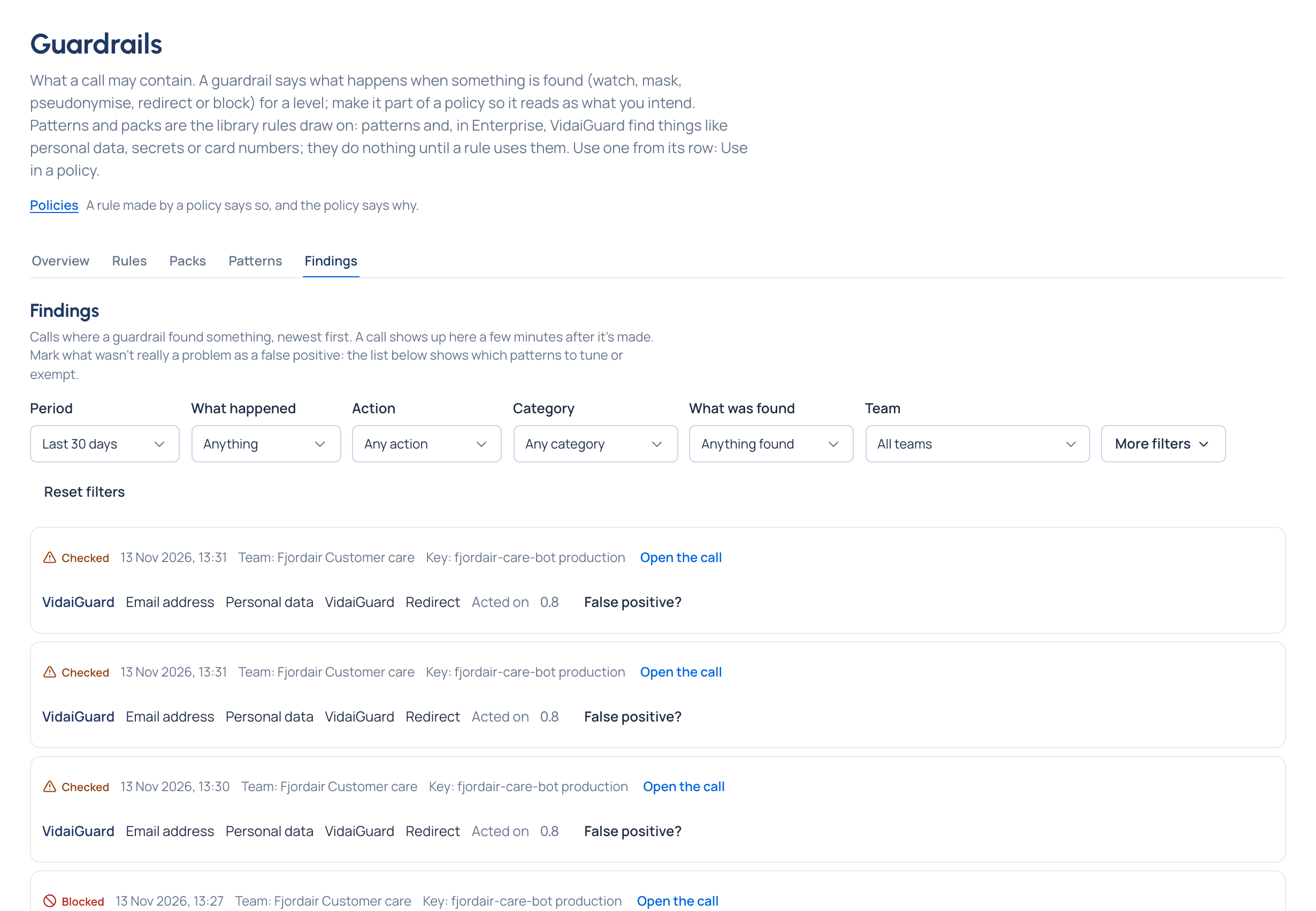
- Guardrails act on content as it passes. Pattern checks and VidaiGuard find personal data, card numbers, secrets, prompt injection and your own internal terms in what's sent to a model. A guardrail then blocks the call, redirects it to an approved model, masks the data, or pseudonymises it: the model sees stand-ins, and the originals are put back in the answer, streams included, so your user sees the real values.
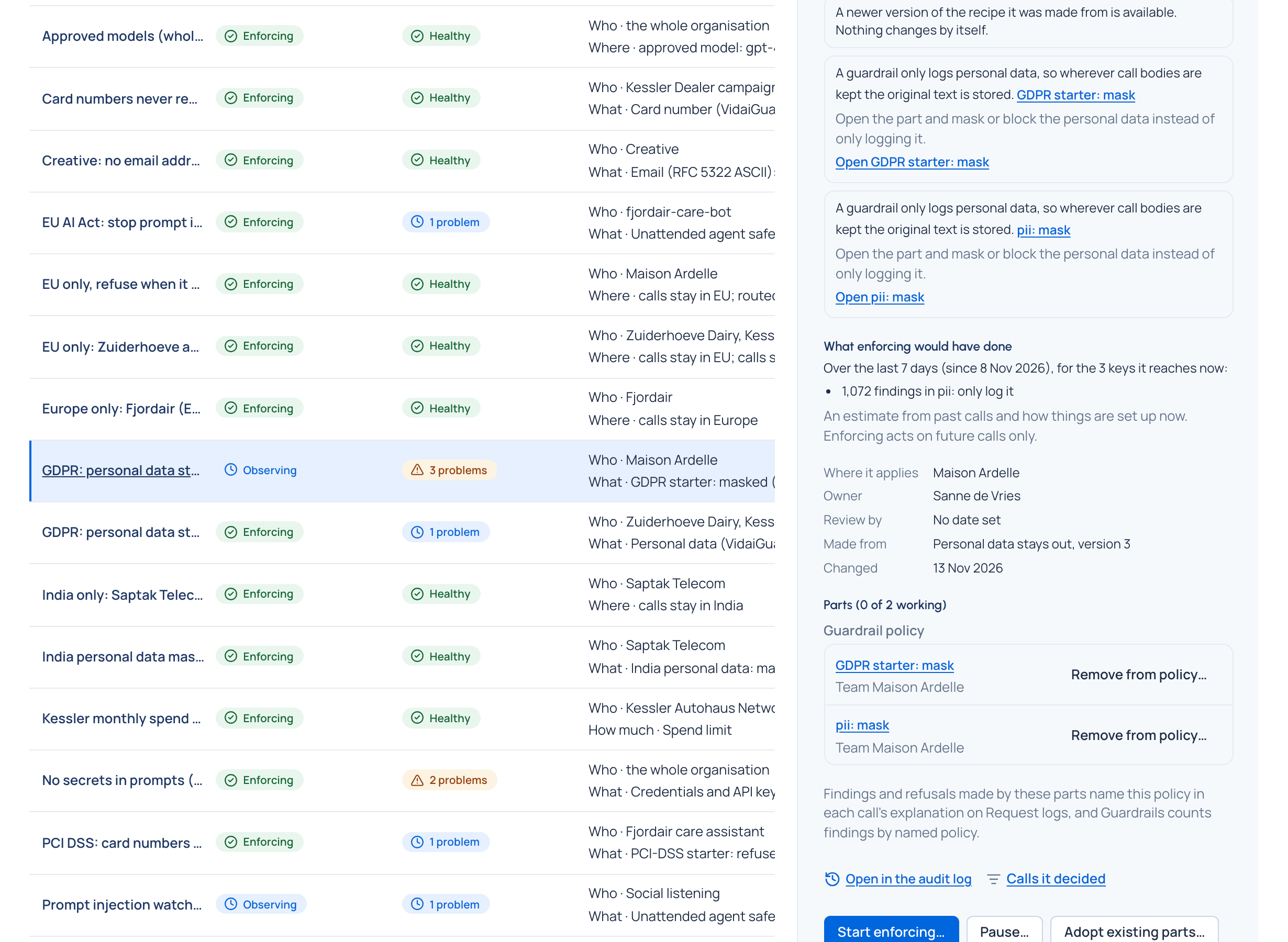
- Observe first, then enforce. A policy can run in observe mode, recording what it would have done, before it changes a single call.
- Policies are named and read as sentences: "GDPR: personal data stays out (Zuiderhoeve, Kessler)", enforcing, pseudonymise. Each one says who it covers and why.
- Exceptions have a reason, and who agreed is recorded. Anyone widening their own access waits for a second admin (a sole admin is never stuck), and every exception sits in one register.
- One switch for an incident. Stop AI traffic stops every AI call on every gateway node, and you see that each node took it.
What changes for you
- Risk acted on, not just observed. The customer's phone number never reaches the model; the record says it was caught and what was done.
- No backlog of alerts. What used to be a finding to chase is a decision already made, with its evidence.
- Changes are safe to try. Observe mode shows what enforcing would have done to real traffic before you commit.
- Proof: in the demo organisation, the guardrail findings from four weeks of calls, each with the policy that decided it.