For operators
You'll run Vidai. It's made to run like any other small service: few parts, plain health checks, and a page that says whether each part is working.
Your problem today
Every new platform service is one more thing to deploy, patch, scale and be paged for, with its own idea of health and its own dashboard.
What Vidai is made of
- The gateway: a single small binary that carries every AI call. It adds well under a millisecond: in its 0.9.0-beta.5 run it carried 47,200 calls a second at a 0.58 ms median (one machine, 32 concurrent callers, every call recorded, a mock provider; not a published benchmark). Several gateway nodes stay in step on one shared configuration.
- The Control room, with the service behind it that keeps your people, rules and records.
- A database for both.
- VidaiGuard Enterprise, beside the gateway, once you set it up; guardrails are complete on pattern checks until then.
All of it runs in your infrastructure.
Watching it
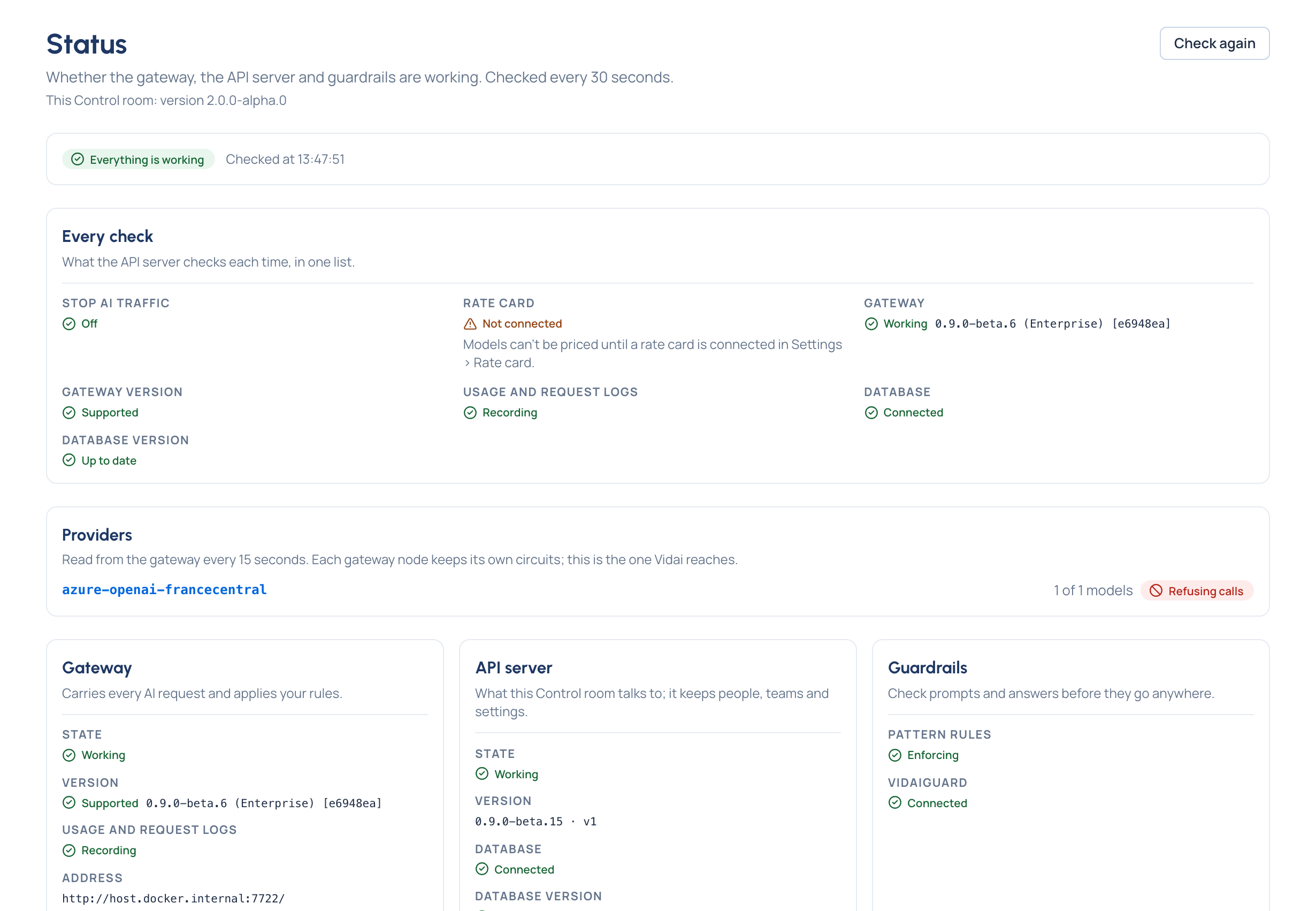
- Status in the Control room says, in words, whether the gateway, its nodes, the database, request logging, Guardrails and the rate card are working, and which gateway nodes are up to date.
- The gateway answers
GET /health. - Prometheus metrics come with the Enterprise edition; what Enterprise includes depends on the features your licence includes.
The team Vidai stands in for
The several services, each with its own runbook, that a homemade gateway grows into. See The stack nobody chose.
Your reading path
- How Vidai works and The parts.
- Provider keys and resilience.
- Safety switches.
- Check that Vidai is working and Set the gateway address your apps use.
- Metrics Enterprise, every one the gateway exports, with its labels.
- Limits and Statuses.