Sending your data to someone else to check your data
VidaiGuard, Vidai's own models for checking content, runs beside your gateway. It finds what a pattern can't, such as a name in free text or a disguised injection attempt, and the data it checks stays in your infrastructure.
The problem
You need to know whether a prompt carries a person's name, a health detail or an attempt to hijack an agent. Regular expressions catch card numbers and email addresses; they don't catch "my neighbour Pieter, who's been unwell". So you reach for a model that understands language, and find that the usual way to use one is to send it the very data you're trying to protect.
Why it stays unsolved
Content checking is often a hosted service: every prompt goes to a third party's API to be scanned, then on to the AI provider. To protect your data, you share it with one more company, in one more jurisdiction, under one more agreement. For the data that matters most, that's exactly the step you can't take.
How Vidai handles it
Vidai checks content in two ways, both inside your installation:
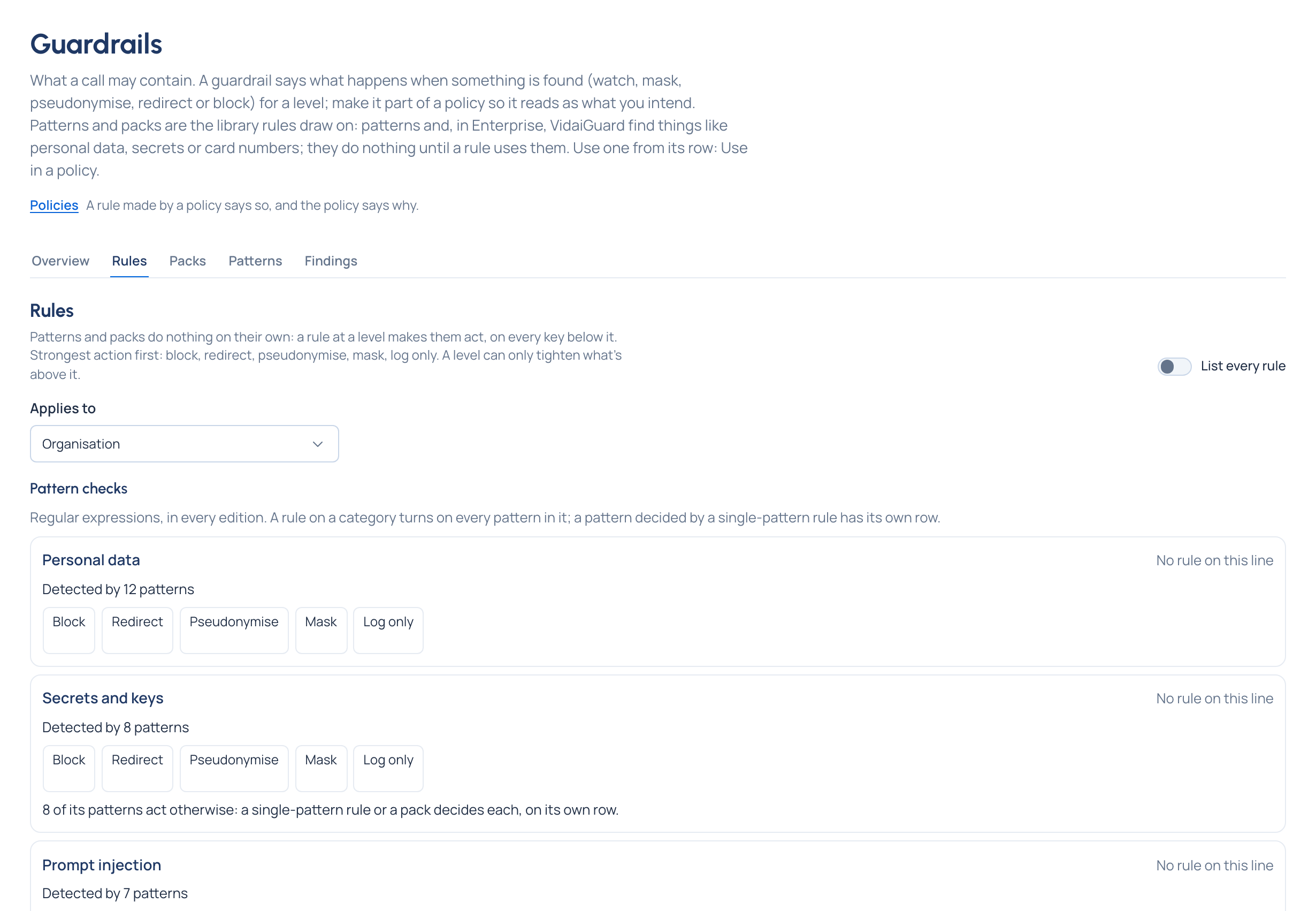
- Pattern checks, in every edition: a library of built-in patterns grouped in categories and packs (personal data, card numbers checked with their check digits, secrets and keys, prompt injection, profanity, regional personal data), plus your own regular expressions.
- VidaiGuard checks Enterprise: VidaiGuard's models run beside your gateway and find what patterns can't: people's names in free text, toxicity, injection attempts written to look harmless. You choose which models run, and can test a sample before you rely on them.
What Enterprise includes depends on the features your licence includes. Guardrails are complete on pattern checks alone: on Community, and on Enterprise until VidaiGuard is set up, everything else on this page works the same, and the VidaiGuard checks in your packs start by themselves once it is.
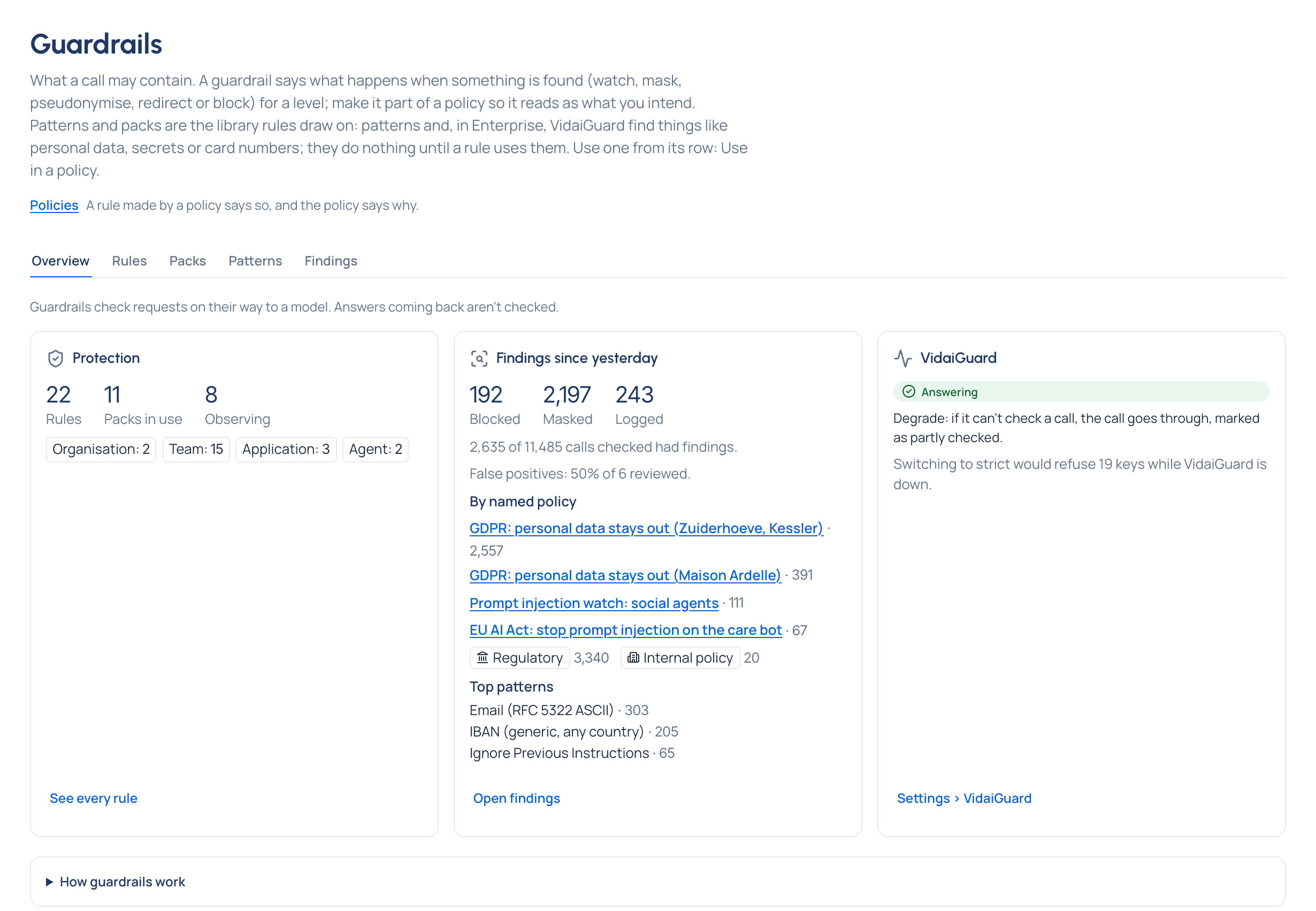
Either way, a guardrail then decides what happens: block, redirect, mask, pseudonymise or log only. If VidaiGuard is set up but isn't answering, you choose whether calls carry on with pattern checks or are refused.
What changes for you
- Language-aware checks without a new data processor. The data being checked doesn't leave your infrastructure.
- One place for every check. Patterns and VidaiGuard work in the same rule, with the same actions and the same findings to review.
- Tune, don't guess. Review findings, mark false positives, and see which patterns need tightening.
- Proof: the demo organisation's Guardrails overview: what was checked, found and done across four weeks of calls.