Prices and the rate card
Pricing AI by hand means a spreadsheet of per-token rates that is out of date the week after someone builds it, and nobody can say which price a call from last month was charged at. Vidai prices every call from a rate card it keeps in step for you, at the price in force when the call was made, and keeps every price it has ever used. You can answer "what did this cost, and why?" for any call, and a mistake in a price feed never re-prices everything at once.
What it is
The rate card is a published list of model prices. Vidai keeps its own copy of it, refreshed on a schedule, and every screen reads that copy, so prices keep working while the feed is down. An organisation admin connects it once in Settings › Rate card; after that, prices arrive without anyone typing them.
Each of your models is priced from a line in the rate card: a provider's model, at a tier (standard, batch and so on), in a region, in one currency. Where the rate card is wrong or doesn't list a model, a manual price takes its place.
flowchart LR
  RC[Rate card feed] -->|kept in step| Copy[Vidai's copy<br/>every version kept]
  Manual[Manual prices] -->|override a line| Copy
  Copy --> Model[Your model's price<br/>now, before, next]
  Call[A call through the gateway] --> Priced{Price in force<br/>at the call's time}
  Model --> Priced
  Priced --> Cost[The call's cost]
How prices behave
- The price in force when the call was made. Every price has a start and, once replaced, an end. A new price applies to calls from its start, never to calls before it. A call already costed keeps its cost.
- Prices follow where the provider runs. A provider's placement chooses the regional price, so the same model can cost more in one region than another.
- One currency per price, never converted. Most lines are in US dollars; some are in euros, yuan or a vendor's credits. Amounts in different currencies are never converted, added or compared. Where a line is published in more than one currency, the provider's own currency is used, then the organisation's Default price currency.
- Free is a real zero; unpriced is never zero. A model the rate card prices at 0, or one someone marked free, reads Free. A model with no price says why instead of showing $0, and every total says how many calls it leaves out.
- A big jump is held for a person. When a sync moves a price by the hold factor or more (3 times by default), the new price waits under Held changes until an organisation admin or Finance accepts or rejects it. The old price stays in force meanwhile. A price that jumps eightfold overnight is more often a mistake in the feed than a real change.
- A price the rate card stops publishing keeps pricing, marked no longer published, until you replace it.
- A manual price overrides its line, every tier. Ending the last manual price brings the rate card's prices back.
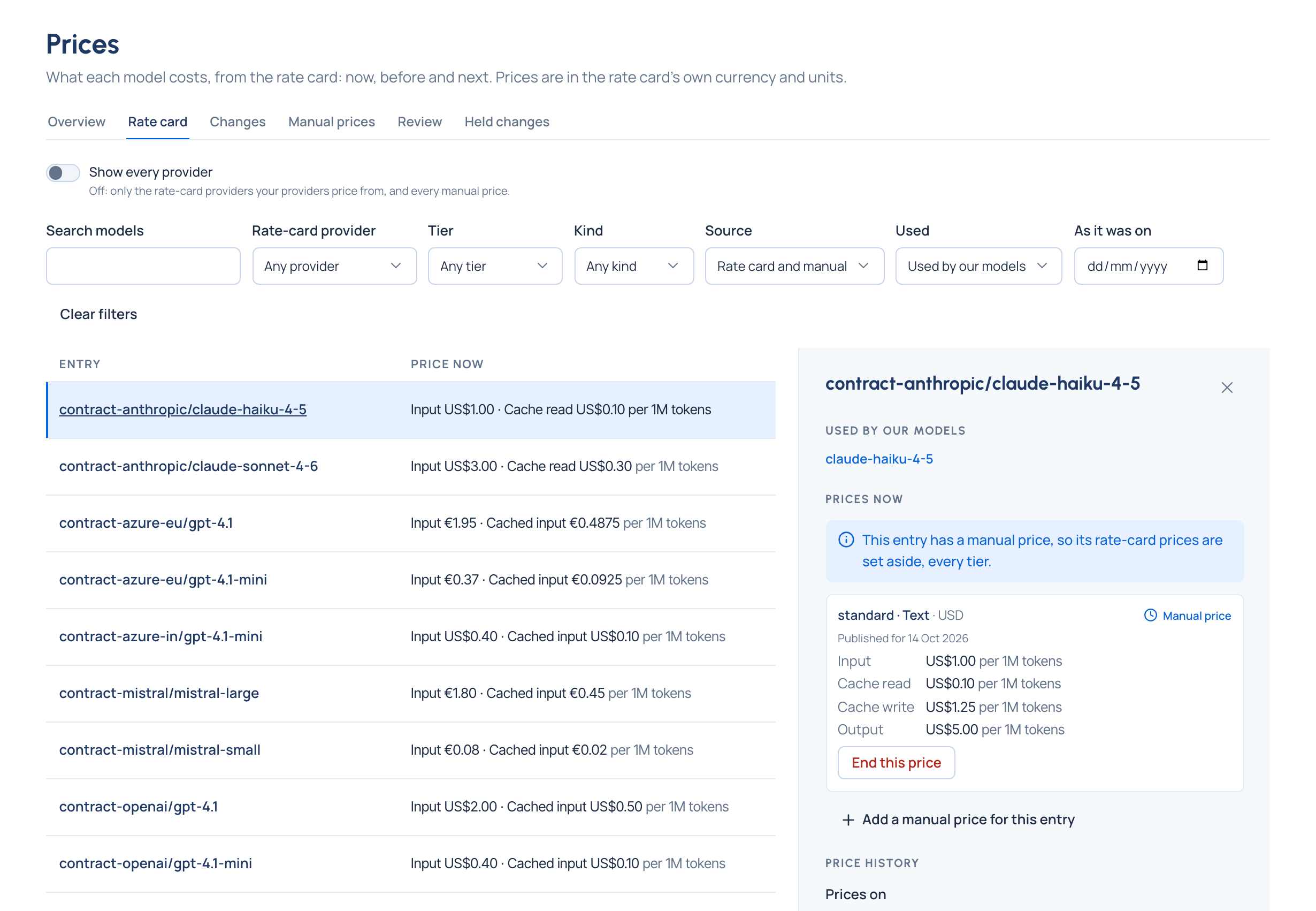
What you see on screen
Money › Prices has six tabs:
| Tab | What it answers |
|---|---|
| Overview | How much of the catalogue is priced: Priced, Free, Needs review, No match, Not in the rate card, Not priced, per provider. Every number opens those models |
| Rate card | Vidai's copy of the card. As it was on shows the whole card on a past day, the prices that priced calls made then |
| Changes | What moved in the rate card, newest first: Went up, Went down or Some up, some down |
| Manual prices | Prices you set yourself, for a model the rate card prices wrongly or doesn't list |
| Review | Switched-on models whose price needs a person. A guess is never used as a price |
| Held changes | Big price moves waiting for a decision, old → new, with how far each moved |

Organisation admins, organisation viewers and Finance see Prices. Organisation admins and Finance add manual prices and decide held changes.
When a price arrives late Enterprise
A price added or corrected with a start in the past changes new calls only, until someone runs a recompute: Vidai then offers to price the calls since that day again, with a dry run first. What Enterprise includes depends on the features your licence includes. On Community, calls already costed keep their cost, and new calls use the price in force. See Cost.
Related
- Cost: how a call's price becomes spend, and who pays
- Budgets: limits that count what calls cost
- Providers and models: where a provider runs, and so which price applies
- Glossary