Every provider wants you on its SDK
Keep the SDK you have and call any provider. Vidai translates requests, streams and tool calls both ways, and tells you, in a header, anything it had to adapt.
The problem
One team wrote its service against the OpenAI SDK. Another chose Anthropic's. The data team lives in Gemini. Now the organisation wants to move a workload to a cheaper model, or keep EU traffic on a provider with an EU region, or try a new model that just came out. Each of those is a code change, in a service that has to be tested and redeployed, by a team that has other plans this quarter.
Why it stays unsolved
Every provider's API is a little different: message shapes, system prompts, tool calls, streaming events, reasoning settings, how usage is reported. Code written for one doesn't run against another. So the provider choice is made once, in code, by whoever wrote the first version, and it sticks. Switching is a project, and the organisation's choice of provider ends up being whatever the code happens to say.
How Vidai handles it
The gateway speaks three formats (OpenAI, Anthropic and Gemini) and translates each into the others, in both directions:
| Your program uses | It can reach models on |
|---|---|
| The OpenAI SDK, or any OpenAI-compatible tool | OpenAI, Azure OpenAI, Anthropic, AWS Bedrock, Google Gemini, Vertex AI, your own servers |
| The Anthropic SDK | The same |
| The Google GenAI SDK, including Google ADK | The same |
- Requests, streams and tool calls travel both ways. A translated stream arrives in your own SDK's events, so an Anthropic client reading a Gemini model still gets Anthropic's stream.
- What a provider can't take is adapted, never a failed call. A setting with no equivalent is dropped or brought
into range, and the answer says so in
x-vidai-adapted, in your own SDK's field names. - The answer says which model really answered, in
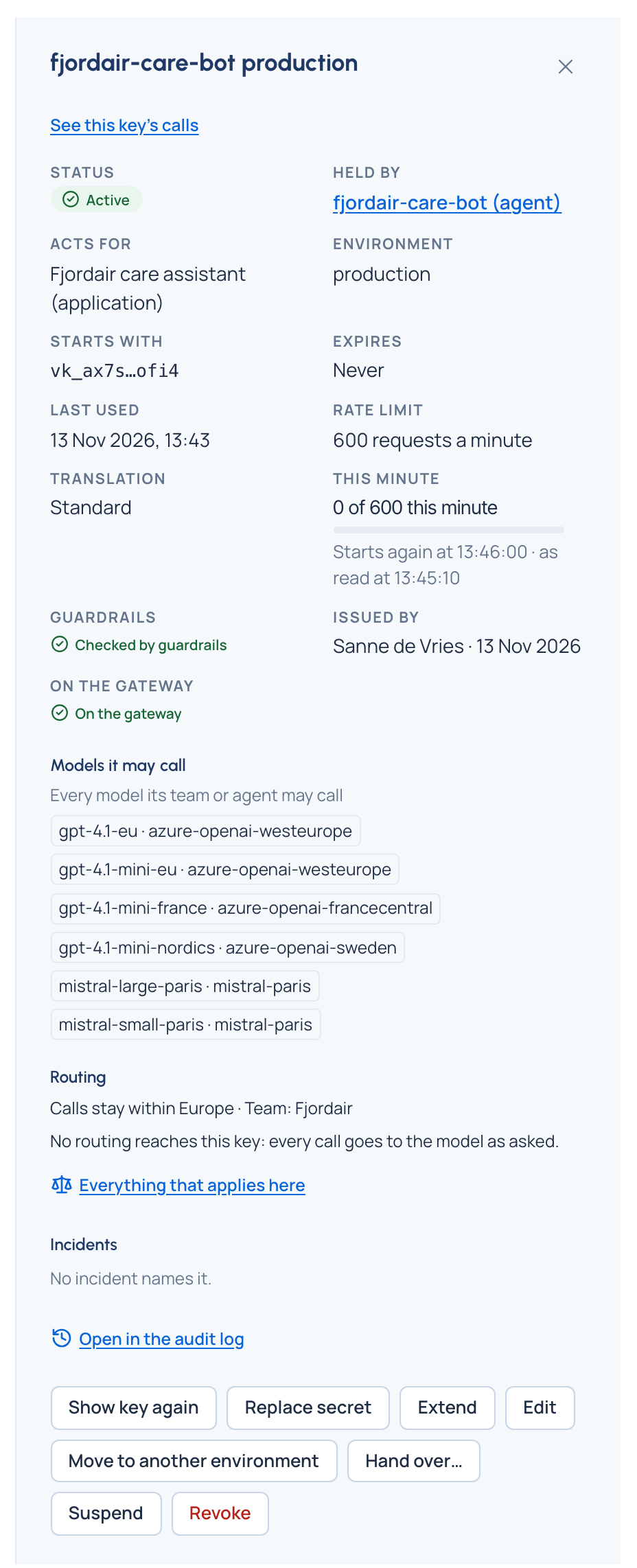
x-vidai-model, whatever name you asked for. - Two ways to translate. Each key has a translation profile: the gateway's standard translation, or one that keeps near-equivalent settings the other format can't say exactly. An admin can let an app choose per call.
What changes for you
- The provider becomes an organisation decision, not a code decision. Routing a model to another provider, or trying a new one on a share of calls, is a rule in the Control room. See Routing and fallback.
- Teams keep the SDK they know. Nobody rewrites a working service to follow a procurement decision.
- You always know what happened. The headers say what answered and what was adapted, and the call's page in Request logs shows the same.
- Proof: the full grid, field by field, is in Any SDK to any provider.