For developers
You want to call models, not maintain the plumbing around them. With Vidai your program keeps its SDK, changes its base address and key, and gets every model your organisation offers, with guardrails, cost and logs handled in the request path.
Your problem today
Provider keys sit in config files. Each provider wants its own SDK, so switching models means changing code. Every service carries its own retry loop, its own logging and its own guardrail code, and when a call fails nobody can say whether it was the provider, a limit or a policy.
Life with Vidai
- One base address, one key. Point the OpenAI, Anthropic or Gemini SDK at the gateway and use a Vidai key. Nothing else in your code changes, and provider keys leave your apps.
- Any model through your SDK. Requests, streams and tool calls are translated both ways, so an Anthropic-SDK
program can call a Gemini model and get Anthropic-shaped answers. What a provider can't take is adapted and named in
a response header (
x-vidai-adapted), never a failed call. - Stable model names. Your code calls a name your organisation chooses. When the model behind it changes version or
provider, your code doesn't.
GET /v1/modelslists exactly what your key may call. - Refusals in words. Every gateway error comes in your SDK's own format, with one code to match on
(
x-vidai-error-code), and the call's page in Request logs says which rule decided it, set where. - Retries you don't write. Fallback chains try the next model before anything reaches your program; the answer's headers say what was tried.
What you'll use
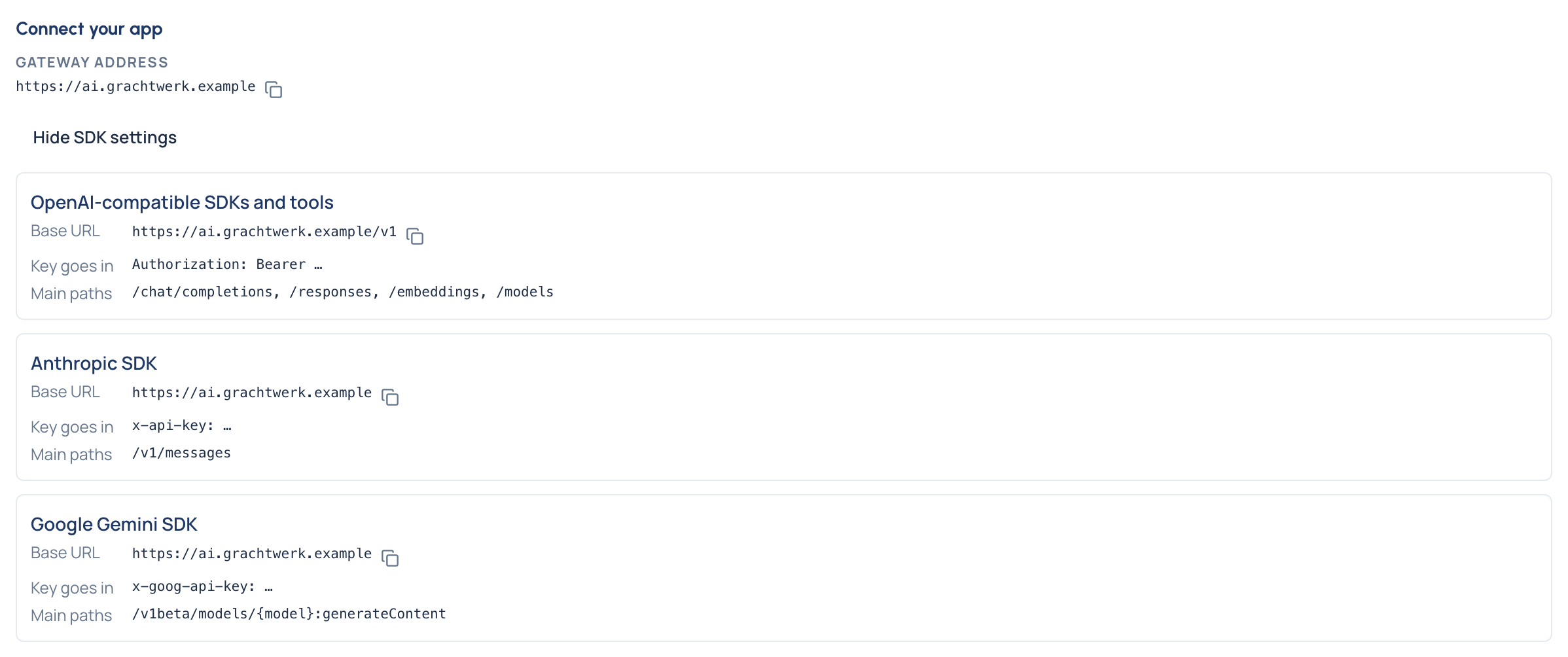
Keys gives you your key and, beside it, Connect your app: the gateway's address and, under Show SDK settings, the base URL, where the key goes and the main paths for each SDK.
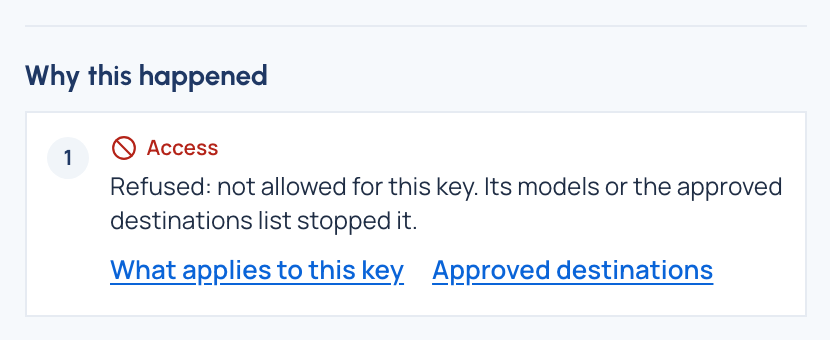
Request logs shows every call made with your keys and your agents' keys. Quote the x-vidai-request-id from an
answer to find the call; Why this happened lists every rule that acted, in the order the gateway weighed them.
Applications & agents registers the programs you run, each agent with its own keys and owners, so a cost or a refusal lands on a system with an owner rather than on "a key".
The team Vidai stands in for
The platform and SRE work behind a homemade gateway: translation across SDKs, failover, key handling, logging and the guardrail code in every service. See The stack nobody chose.
Your reading path
- How Vidai works.
- Connect your first program.
- Keys, Applications and agents and Environments.
- Model names and aliases and Translation between API formats.
- What the gateway adds to a call (Response headers), and Errors and refusals.
- Client integrations for your SDK or framework.
- Request logs and the call record.